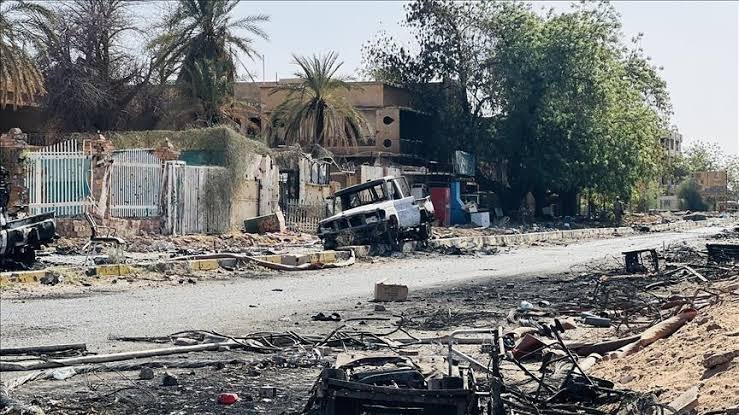
More than three years after the outbreak of the war in Sudan, and over a year since Khartoum was recaptured from the Rapid Support Forces, the “environmental loss” remains one of the deepest wounds left by the conflict. Sudan’s capital, the city hardest hit of all, continues struggling to recover and breathe clean air again. Yet long battles still lie ahead to rid itself of the legacy of destruction, debris, and environmental pollution hidden beneath millions of tons of rubble from destroyed buildings, factories, and burned warehouses.
United Nations reports indicate that the environmental risks resulting from the war in Sudan since April 2023 extend far beyond the visible destruction of buildings and infrastructure, creating a long-term toxic legacy that threatens ecosystems for years to come. The war’s environmental damage is estimated at more than $10 billion, much of it concealed beneath the rubble.
UN experts have warned that Sudan is facing a toxic legacy from the war, as non-inert materials accumulate under the debris, forming a complex mixture of pollutants that require specialized techniques for removal and treatment. They stressed that ignoring this reality would leave Sudan facing new battles to secure a healthy environment and safe living conditions long after the guns fall silent.
A UN Shock
According to the United Nations Environment Programme (UNEP), the environmental hazards resulting from the conflict include industrial and chemical waste caused by the destruction of factories, such as plastic and chemical plants and oil storage facilities, leading to the leakage of toxic substances into the air, soil, and groundwater.
Mona Zain Al-Abidin, Deputy Director of UNEP’s Sudan Country Programme, expressed shock at the scale of environmental destruction in Khartoum during a recent environmental assessment visit to the capital. She warned that what she described as a “toxic legacy” threatens to spread disease and cause deaths for years to come, stressing that the road to lasting peace must include healing the environmental scars left by the crisis.
Improvement, But…
Despite relative improvements in the situation, Khartoum — still the most affected city — continues to suffer widespread contamination from war remnants. Major General Khalid Hamdan, Director of the National Mine Action Center, confirmed that although field teams have made progress, the scale of the challenge remains enormous. He noted that 15 specialized demining teams had destroyed 150,000 unexploded shells in three separate phases during recent operations.
Explosives and unexploded ordnance hidden beneath piles of garbage and rubble remain an ongoing threat. Khartoum’s Emergency Committee announced that 59 explosions involving war remnants were recorded during attempts to burn waste up to the end of last April.
Environmental specialists argue that the recovery of Sudan’s capital depends on repairing these environmental scars and making them an integral part of any sustainable peacebuilding process, combining reconstruction with efforts to combat war-related pollution, so that it does not turn into a continuing silent war.
International reports estimate that Khartoum alone contains around 38 million tons of war debris and building rubble mixed with hazardous materials and unexploded ordnance. Authorities, meanwhile, announced the removal of more than 22,000 tons of waste from central Khartoum and the reopening of 61 streets that had been completely blocked by the wreckage of hundreds of destroyed vehicles.
Overgrowth and Waste
The sanitation sector lost around 90 percent of its equipment due to looting and destruction, causing the collapse of waste collection systems, the suspension of routine cleaning operations, and the accumulation of decomposing garbage in public squares, streets, and residential areas. Medical waste dumped outside designated disposal zones poses a major biological threat that could lead to worsening environmental and health risks.
After three rainy seasons, many abandoned roads have turned into overgrown grassy areas because of dense, uncontrolled vegetation growth. Amid the rubble and destroyed cars, some neighborhoods now resemble deserted ghost towns.
Despite the bleak situation, Khartoum State authorities have begun efforts to rehabilitate the environment in areas brought back under control. Ghada Hussein Al-Awad, Secretary-General of the State’s Higher Council for the Environment, announced a ten-year plan extending from 2026 to 2036 aimed at environmental restoration and recovery. The plan includes pollution treatment and cleaning soil and water contaminated by shelling and industrial and medical waste, particularly around heavily damaged areas such as the Al-Jaili refinery.