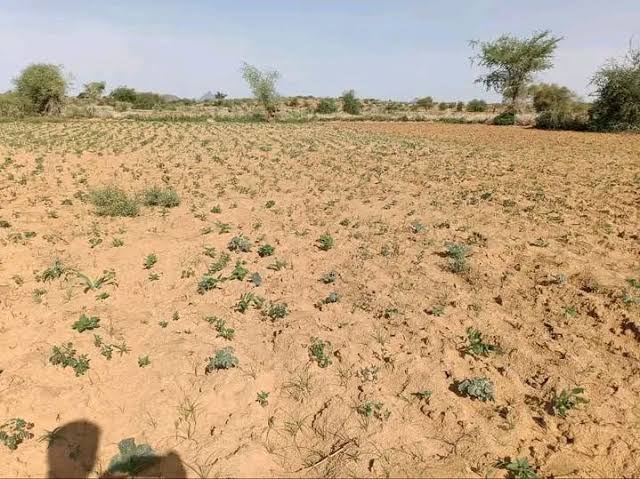
Farmers across Sudan, who have already been struggling to harvest their crops since the outbreak of the civil war in 2023, are facing a new enemy that could push the country back into the grip of famine: the weather.
The El Niño climate phenomenon, which threatens parts of Africa with flooding, has contributed to rising temperatures and drought in Sudan. Pockets of famine have already emerged during more than three years of conflict, particularly in areas under siege.
According to UN officials, humanitarian experts and more than 20 farmers interviewed by Reuters, drought conditions are severely damaging crops and livestock in the southern regions, where rain-fed agriculture provides a substantial proportion of Sudan’s food supply. One prominent farmer expects his harvest this year to be no more than a quarter of what he collected in 2025.
In a warning issued on October 12, the UN-backed Integrated Food Security Phase Classification (IPC) initiative stated that “the risk of famine is increasing in several conflict-affected areas of Sudan, as El Niño-induced drought further deteriorates already dire conditions.”
Data from the US Geological Survey indicate that rainfall between July and September, the peak of the rainy season, was the lowest recorded across the country in more than three decades.
In North Darfur State in western Sudan, rainfall was at its lowest level since 1984, the same year that witnessed a devastating famine in Sudan and Ethiopia.
In North Kordofan State in the central region, rainfall was at its lowest level since 1990, while Gedaref State in the southeast recorded its lowest levels since 1991.
In June, the IPC reported that 5.1 million people in Sudan were facing acute hunger, and the initiative is currently updating these figures. The numbers were expected to decline as the harvest season began in November and December, supported by a relative lull in fighting in some areas. However, El Niño-related drought is now expected to drive these numbers higher.
Samuel Clindon, Sudan Programme Director at the United Nations World Food Programme (WFP), said the agency expects an additional 350,000 people to suffer severe hunger by the end of 2026, with that figure rising to an additional 1.2 million people by August 2027.
Clindon based these projections on figures shared with donors but not widely publicised. The WFP identified Darfur and Kordofan as the worst-affected regions.
“The Livestock Have Become Emaciated”
In North Kordofan State, Mariam Omar pulls weeds from between crops that should have been approaching harvest time. Instead, the plants are withered, surrounded by dry, sandy soil.
“This year is extremely bad,” says Mariam, who works on her small plot of land near the town of Umm Rawaba.
Mohammed Abdelrahman, a farmer who owns approximately 420 hectares in the Umm Rawaba area, says many farmers displaced by the war have begun returning to their lands, only to find them devastated by drought.
Abdelrahman, who also trades in sesame and provides financing to small-scale farmers, estimates that around 40 per cent of the farmland in the area will produce no harvest at all.
At the livestock market in El Obeid, the capital of North Kordofan State, the ribs of cattle protrude beneath their dust-covered hides.
“At this time of year, livestock are usually fat, and everyone makes a profit. But now, with resources scarce during this rainy season, the animals have become emaciated,” says trader Siraj al-Din Abdel Latif.
Siraj al-Din was speaking as he counted banknotes denominated in Sudanese pounds, whose rapidly declining value is fuelling inflation and worsening the population’s hardship.
The WFP is focusing its efforts on delivering food to the five million people most in need, but acknowledges that it cannot reach everyone.
Even among those it manages to reach, the agency has been forced to reduce food rations to make the best possible use of its limited resources.
As of October 17, the WFP had $276 million available to fund its operations in Sudan, less than half its 2025 budget. The agency says it needs an additional $134 million to address hunger caused by the drought.
Speaking to Reuters in Cairo following a visit to Darfur, where he witnessed the effects of the drought firsthand, Carl Skau, the WFP’s Deputy Executive Director, described the combination of declining aid and falling crop yields as a “recipe for disaster.”
“It Is No Longer Just About Bullets”
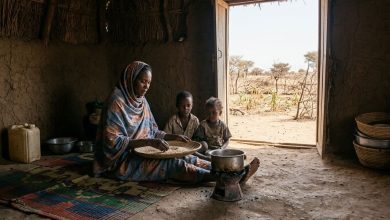
According to Skau, food rations at the sprawling Tawila camp in Darfur, which hosts approximately 700,000 people displaced by the war, have been cut by half. This comes as aid workers report that 9,000 people arrived at the camp between early September and mid-October.
Souad Ahmed, a teacher who has been displaced several times during the war, sought refuge in Tawila in search of food after leaving her village east of El Fasher, the capital of North Darfur State.
“On my way here, many people told me: ‘If you find food and water there, please let us know,’” Souad recounts.
Adam Rijal, spokesperson for Sudan’s General Coordination for Displaced Persons and Refugees, a non-governmental organisation, says hunger has now become the main factor forcing people to abandon their homes, rather than the fighting itself.
“It is no longer just about bullets,” he explains.
Gedaref State has been a key pillar of Sudan’s food supply during the war because it has largely remained outside the fighting. However, it has not escaped the drought.
Sudan in the Grip of Soaring Prices
Imad al-Kabsour, who manages extensive farms covering 14,700 hectares, says: “Even if it rains in the coming period, I will obtain only about 25 per cent of my 2025 harvest.”
He explains that extremely high temperatures are causing crops to burn in the fields.
“We have never experienced a season like this before,” he adds.
According to data from the Reuters climate monitoring service, temperatures in Gedaref State have been between seven and nine degrees Celsius above the historical average since the beginning of October.
The Sudanese government, however, has played down the scale of the threat to the country’s food supplies. At a press conference held in Khartoum on October 8, Sudanese Agriculture Minister Ismat Qurashi said this year’s harvest would be smaller, but “not significantly lower than last year’s.”
“We Don’t Know How This Will End”
Responding to a question about the drought, Abdelrahman Ismail, Executive Director of the Humanitarian Aid and Operations Agency affiliated with the Rapid Support Forces (RSF), told Reuters:
“We have made efforts to coordinate and advocate for an early response, and we believe we can do more if the necessary resources and capabilities are available.”
Humanitarian agencies have repeatedly accused both the Sudanese Armed Forces and their rival, the RSF, of obstructing or preventing aid deliveries during the conflict. Both sides deny these allegations.
The IPC reported pockets of famine in Sudan during 2024 and 2025, including in El Fasher, which was besieged by the RSF for a year and a half. The siege trapped government forces, their allies and as many as a quarter of a million civilians before the city fell to the RSF.
The drought is extinguishing any hope of respite in a country that has endured successive humanitarian crises for decades, including the famine of 1984, which claimed hundreds of thousands of lives across the region.
Alex de Waal, an analyst specialising in famine, says the situation today is “much, much worse in most respects because of the conflict.”
He adds that during the 1980s, the international community mobilised resources to provide assistance, whereas international aid budgets are now facing substantial cuts.
Siraj al-Din al-Tahir, a farmer from Umm Rawaba, recalls what happened in 1984, when crops failed, livestock died and people were forced to flee.
“God had mercy on us, and the US government came with aid and distributed it in our village,” he says.
He adds: “But this year, 2026, we don’t know how this will end.”