Over three years of a bloody war, Sudanese woman Al-Shabak Al-Nabi, now in her eighties, refused to leave her home on Tuti Island, located at the confluence of the Blue Nile and the White Nile in Khartoum, despite a suffocating siege that gradually emptied the island of its residents.
Smiling broadly, she told Agence France-Presse, a year after the Sudanese army regained control of Khartoum from the Rapid Support Forces, “I did not leave my homeland even during the British colonial era, which ended 70 years ago.”
She recalls a saying associated with resisting occupation, often repeated by her daughter: “Our fathers fought colonialism with stones, and the occupiers responded with fire, yet they never entered Tuti, the land of greenery.”
Tuti lies in the heart of the Nile, facing Khartoum, where war erupted in April 2023 between the army and the Rapid Support Forces.
In recent months, many residents have returned to their homes after a siege that lasted from June 2023 until March 2025, when the army regained control of the capital.
Markets have resumed activity, and farmers have returned to their lands, whose fields have historically been a primary source of produce for Khartoum.
Residents have also resumed prayers in the mosque built of red stone, bearing a rusted sign that reads, “Established in 1480.”
A Minefield
In the past, residents and visitors would drink tea sitting on plastic chairs with their feet in the river at the meeting point of the Blue and White Nile, where they merge into a single river flowing north to Egypt. However, Sudanese authorities have now declared that area a minefield.
Salah al-Din Abdulqader, a resident of the island, recalls the years of siege, saying that “nothing entered or left without permission” from the Rapid Support Forces.
These forces sold food, medicine, and fuel at double prices, and their fighters demanded payment to allow passage across the only bridge connecting Tuti to Khartoum.
According to Abdulqader (34), the fighters charged about 350,000 Sudanese pounds (around $90), more than double the monthly salary of doctors.
“We Guard Our Land”
Sheikh Mohammed Eid, who had been active on social media to convey the suffering of the island’s residents, said that Rapid Support Forces fighters “forced us out at gunpoint and took our money,” referring to bribes paid just to be allowed to leave via the bridge.
A Sudanese army officer accompanied AFP journalists during their tour of the island, keeping his distance from interviewees.
Eid, wearing a traditional white Sudanese turban, described how former President Omar al-Bashir’s government had repeatedly tried to remove residents from the island to build resorts and investment projects.
From his home, where the sky is visible through a hole in the caused by an artillery shell, he said, “We are like fish in water; we cannot live outside Tuti.”
Eid was arrested by the Rapid Support Forces two months after he began fundraising to pay bribes that allowed food and fuel into the island to prevent starvation.
Over nine months, he was transferred between several prisons, where he met other detainees from the island, some of whom died in detention.
Under the grip of the Rapid Support Forces, the island was quickly emptied. Out of an estimated 30,000 residents, only Al-Shabak’s family remained, staying behind to care for the grandmother who refused to leave.
Najat Al-Nour, Al-Shabak’s daughter, said, “We are here to guard our land,” describing the residents’ departure as “a major mistake.”
Joy Mixed with Pain
Nusaiba Saad and her family endured living under the control of the Rapid Support Forces for a year and a half, during which homes were raided and belongings, gold, and mobile phones were looted. Residents were accused of spying for the army, she said.
“If we tried to speak, they would say, ‘Be silent or we will shoot you,’” she added.
At night, “we could hear them moving through the houses” abandoned by their owners, along with random gunfire that killed many people.
Saad and her family eventually paid to leave the island when fighters began stealing food and money. She never expected to see her home again, but she returned and said with a smile, “Our street is almost complete… only two families are missing, and they will return soon, God willing.”
Yet her joy is tinged with pain: two members of her family remain missing and are presumed dead, while nearly every family on the island lost someone during the war.
Despite this, she said, as the scent of incense filled a room overlooking jasmine trees, “Coming back is a very beautiful feeling… to find your family, your loved ones, and your home—there is no comfort like it.”
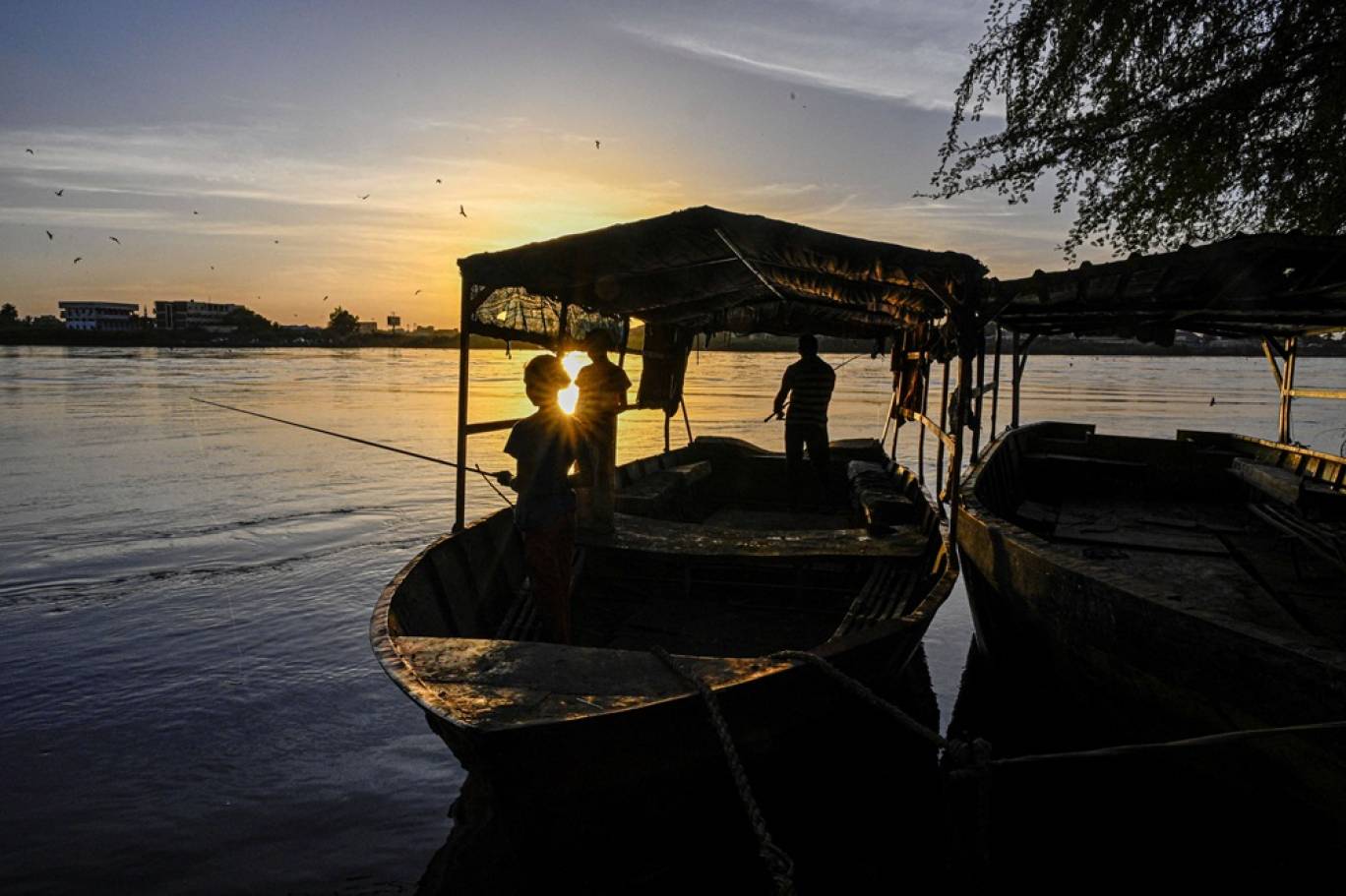
In a nearby field, a farmer walked home carrying a sack full of pumpkins. To the south lay the ruins of Khartoum, with skyscrapers scarred by explosions. To the west, the sky turned orange at sunset, while a fisherman cast his line into the Nile near a family enjoying a riverside outing.
Near the river at dusk, a couple on an outing asked an AFP journalist to take their photo as a keepsake of their day on their island.