Uncertain Fate for Sudan’s Forcibly Disappeared and Missing as Families Remain in Limbo
Mashaweer – Report – Omar Al-Faki
As Sudan’s war enters its fourth year, the number of people subjected to enforced disappearance and arbitrary detention has increased significantly, while their families continue to endure severe psychological distress over the disappearance of their loved ones under unclear circumstances. This is particularly the case amid the refusal of both parties to the conflict to disclose the fate of missing people held in unofficial detention facilities under their control.
The International Committee of the Red Cross (ICRC) said that at least 11,000 people have gone missing in Sudan since the war broke out three years ago, representing an increase of more than 40 percent over the past year alone.
The ICRC highlighted the “deep and ongoing psychological suffering” experienced by thousands of families who “continue to wait for news of loved ones from whom they were separated while fleeing the fighting.”
Grief and Pain
With grief-filled hearts, tearful eyes, and exhausted voices, the parents of forcibly disappeared Abubakar Mohamed Nour Al-Daim, popularly known as “Bakri Wad Al-Sayeih,” appeared in a video circulated online.
In the video, his mother, Mashariq Ali Abbas, describes her struggle to trace her son after he was taken by intelligence officers. In her efforts to find him, she went to a police station, where she was told that he would undergo an investigation and subsequently be released.
The mother continued recounting the circumstances surrounding his disappearance, saying that he was transferred to Wad Madani, the capital of Al Jazirah State. According to the family’s follow-up, he was later moved to Sennar.
The grieving mother said that since then, the family had received no information about her son’s whereabouts or fate. Tears repeatedly interrupted her account as she spoke about her missing son.
His father, Mohamed Nour Al-Daim, provided further details of the family’s painful story. He said their son was arrested in Al-Maileiq in Al Jazirah State and transferred to Al-Kamleen, where he remained for about eight days. He was then transferred to Wad Madani, where he stayed for three months until the city fell under the control of the Rapid Support Forces (RSF). Since then, the family has been unable to determine his fate.
In Vain
Between detention centers, police stations and other places of custody, thousands of families continue searching for the fate of their forcibly disappeared relatives amid a lack of information, widespread secrecy and restrictive laws used to settle old political disputes dating back to the December Revolution, which ousted Sudan’s Islamist government.
Today, the country is increasingly subjected to what is known as the “strange faces law,” in addition to broad and loosely worded legal provisions relating to allegations of collaboration with the Rapid Support Forces. Amid this situation, thousands of Sudanese continue to disappear across the country, from Nyala to Port Sudan and vice versa.
Since the outbreak of the conflict in Sudan, the search for missing people has become a daily ordeal for many families who do not know whether their loved ones are alive in detention facilities or have died. Amid military operations and arrests linked to political positions or security suspicions, enforced disappearance has emerged as one of the most serious human rights violations resulting from the conflict.
Unknown Fate
Human rights lawyer Sami Hussein said that “security authorities in areas controlled by the army have continued to carry out unlawful arrests, while the fate of hundreds of detainees remains unknown. There are also no mechanisms in place to search for missing people or verify their places of detention.”
Speaking to Mashaweer, Hussein noted that “most families of missing people in areas controlled by the Sudanese army face significant difficulties in identifying detention centers and places of custody. There is no institution they can contact in this regard other than legal organizations and human rights activists.”
He added: “On the other side, there are thousands of missing civilians and former military personnel in areas controlled by the Rapid Support Forces who were arrested on allegations of collusion and espionage for the army. Their families are suffering psychologically as a result of their disappearance under unclear circumstances.”
11,000 Missing
In a related development, the International Committee of the Red Cross said that at least 11,000 people have gone missing in Sudan since the war began three years ago.
James Reynolds, the ICRC’s Deputy Regional Director, said that “these figures, which likely represent only a small fraction of the actual number, demonstrate the human cost of prolonged conflicts such as this one.” He noted that shifting front lines had displaced more than 11 million people, some of them multiple times.
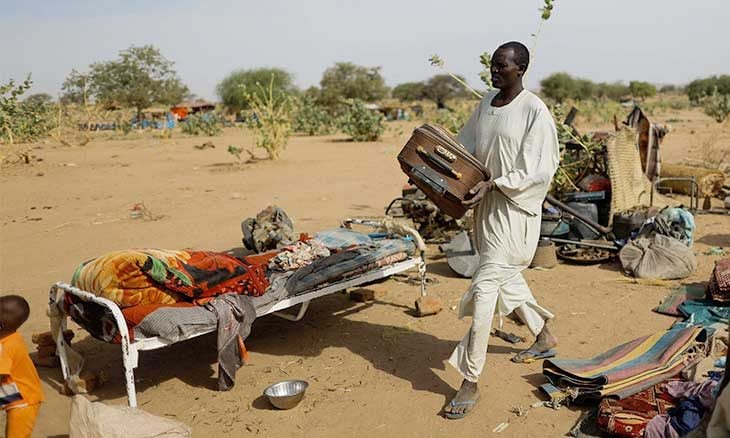
The ICRC added that 4 million of those displaced had fled the country. It stressed that the destruction of many telecommunications networks had resulted in “countless families losing contact with their loved ones, causing deep and ongoing psychological suffering due to uncertainty over their fate.”
The committee said it had helped hundreds of families reconnect with their relatives. Red Cross and Red Crescent societies in Sudan facilitated more than 560,000 phone calls in 2025, as did their counterparts in Egypt, South Sudan and Chad. The organizations also helped resolve 1,100 missing-person cases.