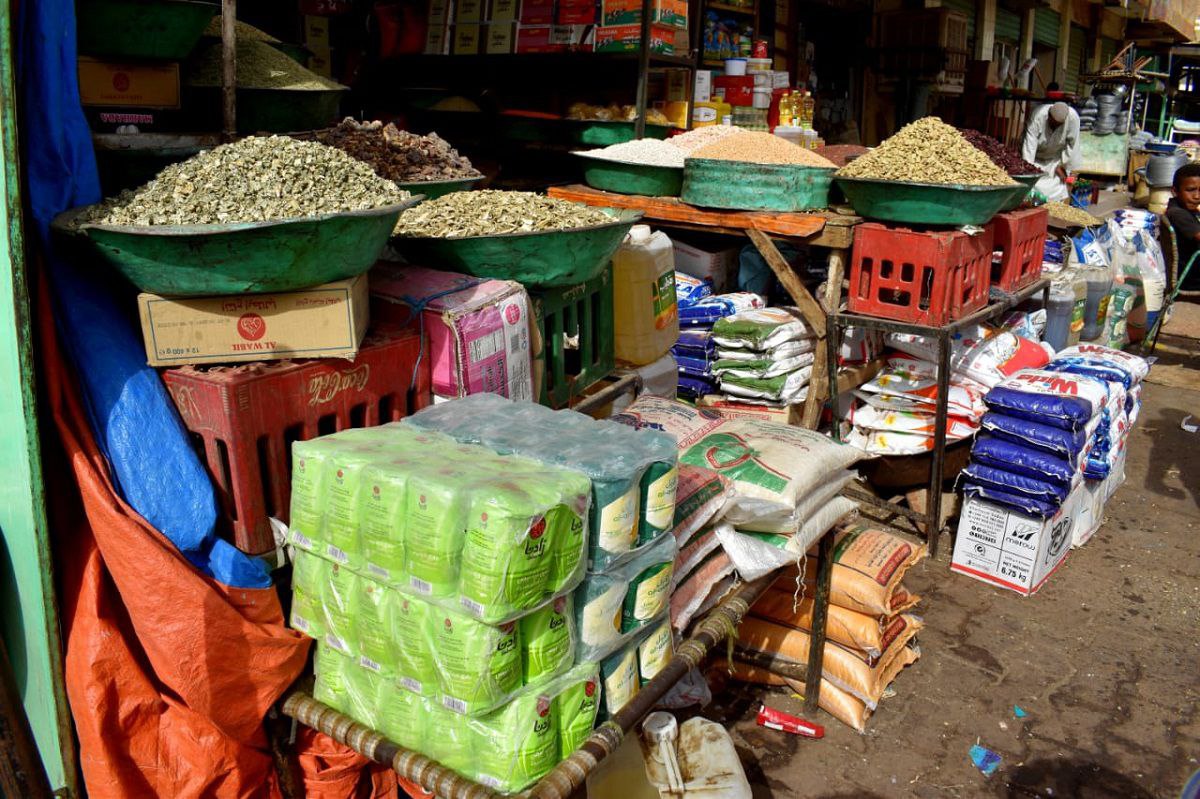
Inflation in Sudan is no longer just a figure debated in economic reports; it is a daily reality creeping into kitchens and reshaping what is placed on dining tables.
With the continuous rise in prices and the erosion of income, the dietary habits of Sudanese families have changed. Balanced meals have receded, replaced by limited options dictated by purchasing power rather than nutritional needs. Food is no longer a matter of taste or culture, but a harsh decision between temporary fullness and deferred health—between what can be provided today and what is silently sacrificed for survival.
Under this deteriorating reality, food has turned into a class indicator, highlighting a growing social and health gap. Daily survival has become a priority over health, and food security is now linked to the ability to pay rather than a fundamental right.
The Incomplete Meal
Amna Youssef, a housewife and mother of five, says: “Inflation has clearly changed the shape of the table in our home. Two years ago, we bought meat once or twice a week, eggs regularly, and vegetables were present in most meals. Today, these items are out of the daily equation. The price of a single kilogram of meat equals the food budget for several days, so it is no longer an option except on rare occasions.”
Amna continues: “Meals now mostly depend on starches, Asida (a traditional porridge), bread, and rice, with a little lentils or beans if available. Animal protein has almost completely disappeared, and even milk is only bought in limited quantities. When I stand in the market, I don’t choose what my children need, but only what I can afford to pay for.”
The Sudanese mother adds: “I feel helpless when I see my children asking for foods they were used to. I try to compensate by increasing quantity over quality, just so they don’t go to sleep hungry. I know this isn’t healthy food, but there are no other options.”
She further explains: “It doesn’t stop at food; it extends to our way of thinking. We have started planning for meals as we plan for an emergency expense. Any new price hike means deleting another item from the list. Even vegetables are now bought by the piece rather than by the kilogram.”
She concludes: “This is the state of most homes around us. The question is no longer ‘What will we eat today?’ but ‘What can we afford to buy?’ Inflation hasn’t just changed our eating habits; it has forced upon us a lifestyle based on minimum subsistence and sacrificing long-term health for daily survival.”
One Meal a Day
Inflation hasn’t just reshaped food components; it has reduced the number of meals themselves. In many homes, three meals a day is no longer a given but a luxury hard to afford. Under the pressure of high costs, families have developed what could be called a “meal economy,” where hours of hunger and fullness are managed with precise calculations to ensure continuation rather than nutritional completeness.
Maryam Abdelrahman, a mother of three school-aged children, points out: “Reducing meals has become an unavoidable choice. We used to eat three times a day, even if the meals were simple. Now, the main meal is just one, usually in the middle of the day. As for breakfast and dinner, it’s something very light or cancelled entirely.”
She adds: “Children sometimes go to school without a real breakfast, relying on tea or a piece of bread if available. I know this affects their concentration and health, but the budget doesn’t allow for more. When forced to choose, I prefer one satiating meal over three incomplete ones.”
Maryam continues: “The elderly in the family are the most affected. My mother is diabetic and needs regular meals, but regular eating has become difficult. I try to allocate part of the food to her, and sometimes I give up my own portion. This happens often, but it has become normal under the current situation.”
She notes: “Reducing meals isn’t just a change in diet, but in the entire lifestyle. Sleep schedules, work, and even moods are now tied to the timing of that single meal. Hunger is no longer an emergency; it is a permanent sensation we live with.”
Maryam believes this “reality leaves a deep psychological impact. The hardest part is the feeling of helplessness. When providing daily food becomes a battle, the family loses its sense of security. We don’t choose hunger; we postpone and organize it so we can last another day.”
Cheap Food
With the declining ability to buy diverse food, Sudanese families have turned to cheaper alternatives that are also lower in nutritional value. This silent shift in food quality leaves long-term health effects that aren’t immediately visible but accumulate in the body, especially in children and women.
Samer Al-Tayeb, a nutrition and public health physician, says: “What is happening is a collective shift toward dietary patterns high in starches and poor in essential elements. Most families now rely on bread, rice, Asida, and sugar as a means to stave off hunger. These foods give a temporary feeling of fullness but do not provide the necessary proteins, vitamins, and minerals.”
The doctor adds: “In clinics, we notice a clear increase in cases of anemia, iron deficiency, and weakened immunity, especially among children and pregnant women. These aren’t individual problems but indicators of a broad nutritional imbalance directly linked to the economic situation. A child who doesn’t get a balanced diet today will pay the price later in growth, concentration, and academic achievement.”
Samer points out: “Women bear the greatest burden. In many homes, priority is given to children, so mothers give up their food portions. This leads to chronic exhaustion and health disorders that go untreated due to poor access to healthcare. Cheap food doesn’t just harm those who eat it, but those who are forced to go without it.”
He continues: “The problem is that this pattern may become a long-term habit. When the body gets used to poor nutrition, it becomes difficult to correct the path later without extensive interventions. We are facing a deferred public health crisis whose results will appear even if the economic situation improves partially.”
The Nutritional Gap
For his part, economic researcher Moataz Ibrahim explains: “Inflation has redrawn the nutritional map of society. When prices rise faster than incomes, food becomes the first area where inequality appears. Families with fixed or limited incomes are forced to cut quality and quantity, while capable groups maintain their dietary patterns without much change.”
He adds: “This division appears not only in the type of food but in its results. Children in affluent families continue to get protein, fruit, and dairy products, while their peers in poor families suffer from chronic malnutrition. Over time, the nutritional gap turns into a health and educational gap, then an economic one.”
Moataz clarifies: “The most dangerous thing about this situation is its cumulative nature. Nutritional poverty doesn’t just produce immediate effects; it creates a closed loop. A child who grows up with malnutrition has fewer opportunities for learning and work in the future, which reproduces poverty itself. In this sense, inflation doesn’t just squeeze the present; it shapes the future of society.”
He believes that “the absence of effective food protection policies makes the market the sole arbiter. Support is limited and community initiatives are not enough to bridge the gap. In this environment, food turns from a basic right into a commodity that determines an individual’s social position.”
The economic researcher concludes: “What we see today is not just a living crisis, but a social reclassification through food. If this path continues, we will face a society divided nutritionally and health-wise, where the ability to purchase determines not only what we eat, but our very chances in life.”