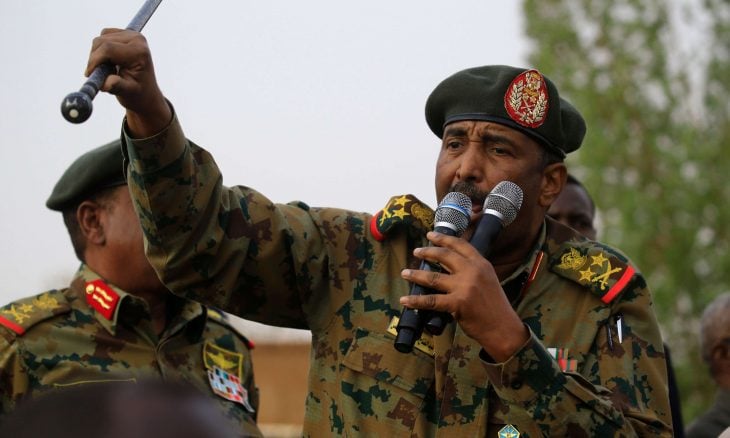
A statement by Sudanese army chief Abdel Fattah al-Burhan calling for a return to the country’s old national flag, adopted at independence in 1956, has sparked wide debate across social media platforms. Supporters view the move as a revival of a national symbol, while opponents consider it a political attempt to create a side battle far removed from the ongoing war and daily suffering.
The old flag consisted of three colors: blue representing the Nile River, yellow symbolizing the desert, and green for agriculture. It was replaced in 1970 during the rule of former President Jaafar Nimeiri with the current flag—horizontal stripes of red, white, and black, with a green triangle—later seen by some as linked to military regimes.
Burhan made his remarks at a memorial ceremony for members of the Sudan Liberation Movement (SLM) led by Minni Arko Minnawi, saying, “The flag raised by our forefathers at independence must return,” stressing the “need to rebuild the Sudanese state from the ground up.”
He added that options for resolving the crisis had become limited due to the scale of bloodshed, casualties, and suffering in large parts of Sudan, particularly in Darfur and El Fasher.
A Mere Symbol
Political analyst Abdelqader Bakash said, “Differences of opinion over returning to the independence flag or keeping the current one are natural in a country with diverse identities and political backgrounds.” He added that every side has its justifications tied to its vision of national identity and the country’s future path. “A flag is ultimately a symbol that cannot bear more than its capacity, while the real consensus among Sudanese remains rooted in the need to unify the country and end the war.”
Bakash continued, “I believe it is a symbolic step with little real impact, especially since the general public rallies around the current flag. The country urgently needs unity in the face of ongoing conflict and crises. At this moment, most Sudanese are focused on when the war will end, and many view the debate about changing the flag as a distraction. Even if there were an intention to change it, such a move must happen through a proper referendum—something impossible now given that several states are outside the control of the current government in Port Sudan.”
An Offhand Remark
Political analyst Ahmed Khogali said, “The idea of changing the flag, as mentioned by the army chief, seems more like an offhand remark made during a funeral speech. But Sudan’s media landscape often inflates passing comments into major political issues, turning them into matters of public debate.”
Khogali explained that Burhan’s comment may be understood as a symbolic signal of the government’s readiness to implement significant structural changes in the coming phase, “not necessarily an actual push to debate the flag itself.”
He added that in light of discussions regarding new political arrangements with Minnawi’s movement, the remark may simply reflect a broader political flexibility, “while new media tends to amplify such hints by nature, even when they may originally be trivial details.”
A Deep Divide
Social media platforms were flooded with contrasting reactions to Burhan’s comments. Sudanese users were sharply divided between those who felt the proposal restores national symbolism and others who viewed it as a distraction from the realities of war.
Supporters—many aligned with the army—argued that returning to the 1956 flag would “restore state prestige” and revive “national symbols predating coups,” saying the flag reflects “a period of unity before later polarization.”
In contrast, civilian activists dismissed the move as an attempt to “distract from the war,” with widely shared posts stating, “Before the flag, stop the war.” Others labeled the proposal “a political message unrelated to national identity, aimed at manufacturing new legitimacy.”
Some influential pages mocked the idea, writing, “The flag won’t save the country—ending the fighting will.”
Sharp Criticism
Responses extended beyond online comments to harsh criticism from activists and political figures who said Burhan’s statements reveal a disconnect from the realities of war.
Activist Mohammed Othman argued that “Burhan’s talk of changing the flag is nothing more than a diversion at a time when Sudan needs full focus on the real battle.”
He added, “If Burhan proposed changing the flag merely as a personal idea, then it is rejected because it ignores the existential challenges facing the country. Nations move forward, not backward. And if the moment he refers to was truly foundational, what exactly was built in that era? Was it truly a moment worth returning to?”
Othman stressed, “What is needed now is not debate over symbols but clear determination of ally and enemy, and the mobilization of all efforts to stop the war. Leadership’s awareness of this moment should be the top priority.”
The Worst Turning Point
In a similar tone, activists criticized what they described as the state leadership’s “detachment from field realities.”
A widely circulated post read: “Hundreds of soldiers are falling in Babnousa, and a military unit has collapsed in West Kordofan, while Burhan speaks from Port Sudan about flag colors as though the country isn’t on the brink of total collapse.”
The post continued, “Six full years in power and Sudan has reached the worst turning point in its modern history—a war that destroyed everything and displaced millions. Today, as cities and youth are buried in silence, Burhan stands far from the battlefield, busy with rhetorical talk about symbols and colors.”
—
A Battle of Identity
Activist Mohammed Jibreel believes Burhan’s proposal goes beyond national symbolism and enters a broader struggle over identity and the direction of Sudan’s political and cultural alignment.
In a widely shared post, he wrote, “Arab states’ flags are not random—they reflect deep political and cultural backgrounds tied to unity and liberation. Burhan’s proposal to return to the independence flag is not just an attempt to appeal to Darfur movements, but a broader step toward crafting an isolationist identity for a lost Sudan—one that distances it from its Arab belonging and places it at odds with both Black Africa and the Arab world.”