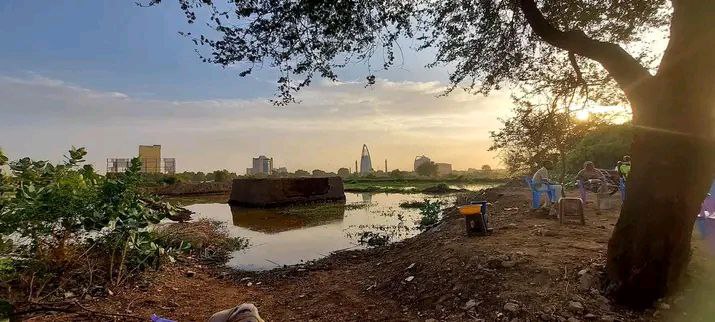
Residents of Khartoum Bahri (Khartoum North), one of the three cities making up Sudan’s capital, are living in a state of complete paralysis. Despite nearly a year passing since its take over by Sudan Armed Forces (SAF) from the Rapid Support Forces (RSF) in March 2024, the city suffers from acute food shortages and frequent power and water outages. The city is now suffering from lack of health, education, and transportation services, compounded by the collapse of bridges connecting it to Khartoum and Omdurman. This has deepened the city’s isolation, as state-led maintenance and reconstruction efforts have largely ignored the area compared to other parts of the capital that were taken over by the Sudan regular army, exacerbating the humanitarian crisis.
The “Bahri Human Rights Observatory” described videos circulating on social media which suggest life has returned to normal as misleading. The observatory stated that these clips do not reflect the harsh reality of citizens living in near-total isolation from the rest of the capital. According to the group, Bahri is passing through its worst phase since the conflict between the Army and the RSF began on 15 April 2023, with basic services collapsing and economic activity falling to unprecedented lows.
The observatory noted that the destruction of main roads has made entering or leaving the city a difficult and dangerous mission. Residents are forced to take long, dangerous, and expensive alternative routes to Omdurman to meet their basic needs. Commercial activity has plummeted to less than 10% of pre-war levels due to the halt of goods movement, market closures, and disrupted supply chains.
Lack of Oversight
Jahid Khalifa, a resident of Bahri, described the situation inside residential neighbourhoods as extreme. “We are living on the margins of life,” he said, citing the inability to provide daily necessities, especially food, due to the lack of stable work and skyrocketing prices. He added that residents must travel long distances to Omdurman markets, a journey that has become a financial burden most families cannot afford. He also highlighted the lack of government oversight to curb the greed of those exploiting the crisis and the absence of public transportation.
Khalifa pointed out that the city’s landmarks are vanishing due to state neglect regarding repairs, particularly the bridges. This has left residents trapped in a narrow area lacking the requirements for life. Many have resorted to buying generators or solar panels, which the majority of the population cannot afford.
Catastrophic Situation
Ahmed Mohammed, located on Al-Mauna Street in Bahri, confirmed that the situation is catastrophic. “Life has not returned to normal,” he said. “The revival of a few markets does not represent the real life inside the city. The main streets and old neighbourhoods stand as witnesses to the destruction.”
He noted that before the war, Bahri was considered one of the capital’s sophisticated, bustling areas. Now, the suffering is limitless. He highlighted that many residents stayed in their homes throughout the war, particularly in densely populated areas like Deium Bahri, leaving them vulnerable to violations, killings, and liquidations in the streets and inside their homes. He called for “justice in the provision of services,” specifically water, electricity, and the reopening of hospitals.
Ongoing Consequences
Community activist Tibyan Fathi stated that after more than two years of facing the horrors of war, hunger, disease, and fear there is a clear environmental decline in most parts of the city. She noted that after calls for voluntary return following the city’s take over, residents were shocked to find Bahri ignored by the state. Some believe this neglect is intentional, stemming from accusations that those who remained in the city were “collaborating” with the RSF. Fathi added that the closure of hospitals has forced further internal displacement. She described Bahri as a “broken rib” of the capital, unable to breathe because it has not been granted a chance at life again. This ongoing neglect has led many displaced residents to postpone their return.