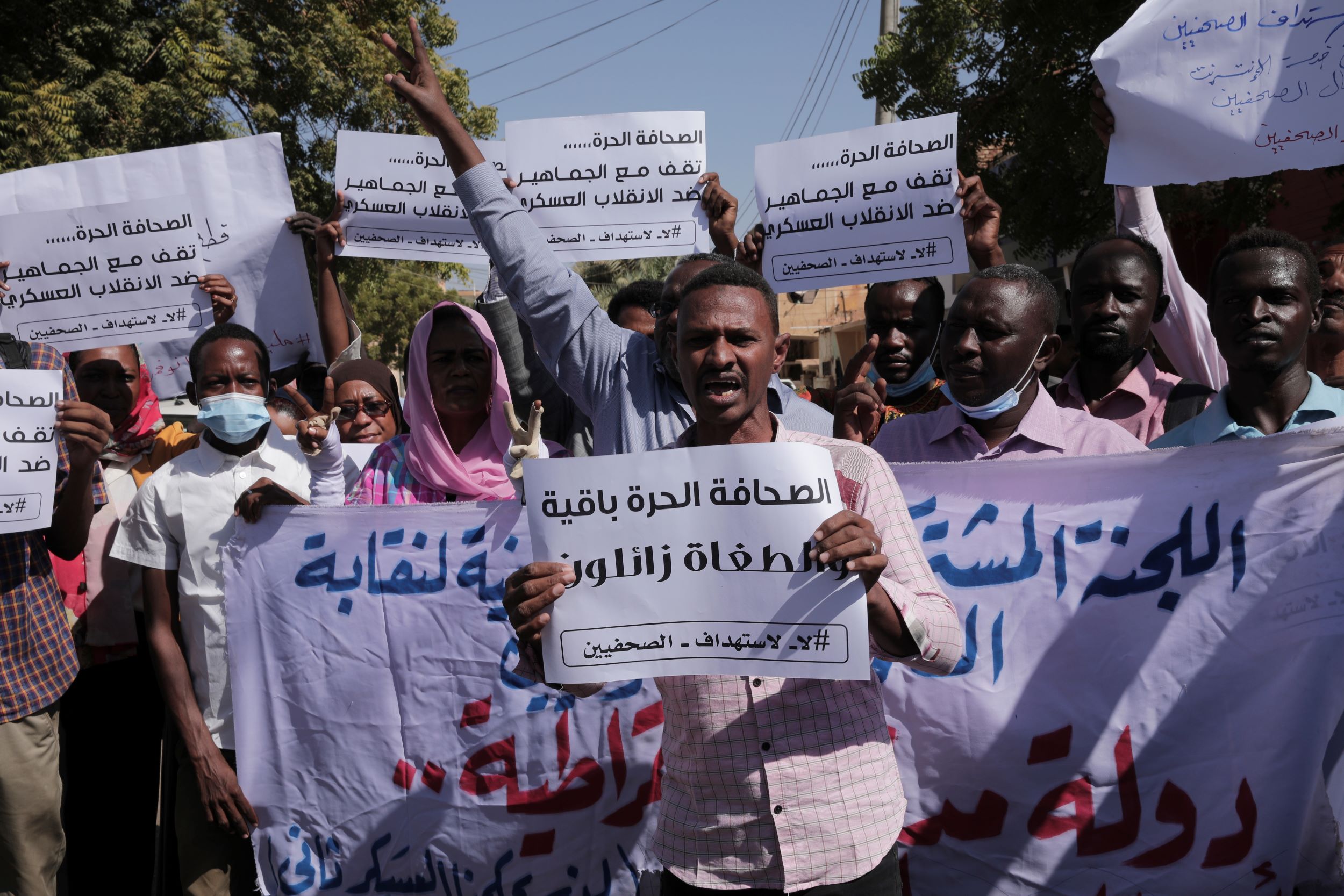
Recently, there has been a surge in direct targeting of Sudanese media professionals and journalists by both warring parties, the Sudan Armed Forcez (SAF) and the Rapid Support Forces (RSF) across their respective areas of control. This has resulted in significant violations directly threatening their lives, forcing them to expect the worst possible outcomes, including killing, arrest, and assault.
Hundreds of journalists have faced detention, kidnapping, and enforced disappearance. Both sides have exerted immense pressure, including death threats, physical liquidation, confiscation of equipment, and the closure of media institutions. Since the outbreak of war in April 2023, the total number of documented violations against journalists has reached 590, classified according to the nature of each incident.
Killings and Arrests
According to a report monitoring violations against journalists and press freedoms, the year 2025 saw a massive increase in victims, with 14 journalists and media workers killed. Beyond the killings, the report recorded an increase in the total number of enforced disappearances to six cases, while the total number of arrests, detentions, and legal prosecutions reached 17. Furthermore, cross-border violations, threats, hate speech, and defamation rose to 27 cases.
The Sudanese Journalists Syndicate report highlighted the city of El-Fasher as one of the most dangerous hotspots for violations in 2025. It noted the disappearance of three journalists in the city prior to the massacres that coincided with the RSF takeover of the North Darfur capital on 26 October 2025, with no information available regarding their whereabouts or conditions. The report pointed out that “continuous shelling, lack of security, and the near-total shutdown of telecommunications and internet services in Al-Fashir hindered documentation and restricted journalists’ ability to transmit information, creating an environment of darkness.” The report emphasized that documented violations likely represent only a limited portion of the actual reality.
Systematic Targeting
In this context, Sudanese journalist Ashraf Abdelaziz stated that the Syndicate’s 2025 report reflects a “dramatic and tragic shift” in the landscape of press freedom. He argued that violations are no longer just accidental incidents imposed by war, but have evolved into “systematic and organized targeting” aimed at assassinating the truth and depriving society of awareness regarding ground events.
“Monitoring 67 direct violations, including the killing of 14 journalists in a single year, places us before the most dangerous reality in modern Sudanese press history,” Abdelaziz added, noting that the system for protecting civilians has collapsed, replaced by policies of impunity.
He further explained that Al-Fashir serves as a living witness to this dark reality, where documentation itself has become a life-threatening adventure. He noted that all conflict parties and security entities now view the “independent word” as an existential threat that must be silenced.
Cross-Border Violations
Abdelaziz noted that these threats are not limited to journalists inside the country. Cross-border violations pursue journalists in exile, where systematic hate speech and incitement brand anyone seeking to report the reality as a “traitor.”
He called on the international community and human rights organizations to take historical responsibility, stating that “silence regarding the direct targeting of Sudanese journalists is a green light for continued repression.”
Threats and Dangers
Hossam El-Din Haider, former Secretary-General of the Sudanese Press and Publications Council, indicated that journalists face various systematic attacks intended to prevent them from reporting facts. He emphasized the urgent need for mechanisms to protect journalists by obligating the Sudanese Army and the RSF to apply international laws, specifically the Geneva Conventions and international human rights law.
A Contrasting View: “Good Conditions”
On the other hand, Bashir Suleiman, a member of the Sudanese Journalists Union, claimed that journalists in Army-controlled areas have not faced violations and are working freely, including those working for foreign media.
Suleiman stated that journalists obtain work permits according to the law and can access sources without restriction. He argued that “some journalists work according to specific agendas dictated by countries fueling the armed conflict,” suggesting that taking measures against them is a “legitimate right under war conditions.”
Concerns for Muammar Ibrahim
Amidst this atmosphere, the Committee to Protect Journalists (CPJ) and 80 human rights organizations expressed concern over the continued detention of journalist Muammar Ibrahim by the RSF, calling for his immediate release.
Ibrahim appeared in a video on the second day of the RSF takeover of El-Fasher (October 2025) with armed men, stating he was caught while trying to leave the city. On 04 November 2025, the RSF broadcast a video of him alongside their spokesperson, who stated that Ibrahim faces charges of “insult” for using the terms “militia” and “Janjaweed” to describe the RSF, viewing these terms as a breach of the neutrality required of journalists.