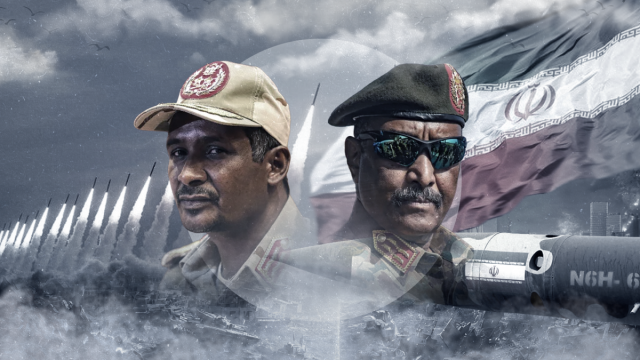
With the escalation of military operations launched by the United States and Israel against Iran, many Sudanese have begun to fear during their discussions on social media that this war will lead to the ignoring of the ongoing conflict in their country between the army and the Rapid Support Forces (RSF), which has lasted for three years. This would mean a prolonged duration at a time when they were pinning hopes on reaching an agreement to end this conflict in light of the intensive efforts led by the United States and Saudi Arabia.
So, what are the repercussions and impact of this war on the reality of the burning conflict in Sudan, whether in terms of logistical and military supply and others—especially since there are international and regional parties accused of fueling this conflict—or in terms of the path toward a peaceful solution pursued by the international “Quartet” represented by Washington, Riyadh, Cairo, and Abu Dhabi?
Regional Shock
Political affairs researcher Urwa Al-Sadiq stated, “Available data shows that the war between Washington and Tel Aviv on one side, and Tehran on the other, has begun to produce a complex regional shock with two parallel paths reflecting on the Sudanese theater. A logistical-economic-security path related to the disruption of sea and air transport corridors, high shipping and insurance costs, and increased navigation risks; and a political-diplomatic path related to the preoccupation of the most influential powers in the Sudanese file with the priorities of the war and its direct security repercussions, which pressures the time and resources of mediation and rearranges regional and international priorities.”
He continued in his analysis: “On the military and logistical dimension inside Sudan, the UN Security Council Panel of Experts reports confirm that the Sudanese war is originally based on external supply systems, smuggling networks, and war economies extending across borders, including supply lines for fuel and weapons via Chad, Libya, and South Sudan, with indications of using airports inside Darfur as supply alternatives during some periods.”
He added: “In parallel, an intersection has been observed between the paths of the war in Sudan and Iranian influence through the supply or facilitation of drones, according to multiple testimonies, flight tracking, and satellite images, amid official Sudanese denials and varying degrees of verification depending on the incident—an element that remains highly sensitive from the perspective of accuracy and detailed certainty.”
He went on: “On the political-diplomatic dimension, the structure of mediation efforts—from Jeddah to Geneva to the African Union and IGAD tracks to the international Quartet track—was already facing a fragmentation of paths, divergent mediator agendas, and the intransigence of Sudanese parties who are increasingly convinced of the possibility of a military resolution with external support. This makes the impact of the new regional shock more likely to shrink the available diplomatic space in the near term.”
Al-Sadiq explained that “the war against Iran makes a contraction of the diplomatic space available for Sudan likely in the short term, with the potential emergence of a pressure window in the medium term aimed at reducing Tehran’s—and perhaps Russia’s—foothold on the Red Sea coast. This could raise the cost of continuing the Sudanese war for the parties’ supporters and rearrange incentives toward a conditional humanitarian truce and stricter compliance mechanisms.”
He continued: “The most sensitive part remains the details of military supply in terms of volumes, types, and payment paths, as much of this is undeclared or disputed. Therefore, general trends supported by reliable sources are mentioned, and unresolved details are left as unspecified in public sources.”
He stressed that at the level of the two parties to the Sudan war, the army’s reliance on drone support makes the war against Iran capable of pressuring the hidden link of any direct supply from Tehran, whether by disrupting aviation or escalating political pressure to prevent the arming of a party described as being close to Tehran. This might push the leadership to deepen reliance on alternative suppliers or local manufacturing and assembly, or toward a political trade-off that reduces exposure to Iran in exchange for diplomatic, economic, and military gains from the Quartet or Europe, especially if the cost of being stigmatized as an Iranian sphere of influence on the Red Sea rises.
Competition Knot
The political researcher noted that “regarding the Rapid Support Forces, the supply network documented by the Panel of Experts is described as flexible with multiple channels through desert convoys, smuggling, and routes via Libya and Chad, with indications regarding the use of Nyala airport as an alternative to speed up supply compared to long land routes. This may make the impact of the Gulf shock less severe in the short term, while vulnerabilities remain linked to high operating costs and the war economy’s dependence on multiple service chains.”
He added: “Temporally, it is likely during the short horizon extending from weeks to three months that risks of tactical escalation inside Sudan will rise due to the security preoccupation of mediators and the parties’ drive to achieve field gains before a new wave of pressure forms or before supply lines change, with the probability of a sustainable calm remaining medium to low without verification, monitoring, and enforcement arrangements.”
He increased: “As for the medium horizon (three to 12 months), the direction of the Sudanese war will be determined according to the course of the war against Iran toward containment or expansion, and according to the ability of the Quartet and the international community to push a regional trade-off that prevents Iranian or Russian positioning on the Red Sea, in exchange for incentives and pressures on the Sudanese parties. This could open a window for a humanitarian truce or a fragile ceasefire if the cost of supply rises and is accompanied by cohesive political pressure.”
Al-Sadiq viewed the long-term horizon as follows: “In the event that a highly militarized environment takes root toward the Red Sea and base arrangements increase on this coast, Sudan may turn into a chronic competition knot instead of an internal conflict with external extensions, with the rise of risks of proxy wars, state fragmentation, and a war economy, linked to the file of the Russian naval base currently being activated or moved, according to reliable coverage.”
He considered the most prominent potential negative aspects of the Sudan war to be the contraction of short-term diplomatic attention, weak follow-up on mediation and compliance mechanisms, high costs of commercial and humanitarian supply, and the potential for parties to rush toward tactical escalation to achieve gains before a new pressure wave forms, with the potential expansion of the war economy and smuggling networks due to scattered international focus.
He continued: “On the other hand, the most prominent potential positive aspects consist of the possibility of forming a broader regional-international pressure window to limit Iranian and Russian positioning on the Red Sea, which raises the cost of continuing the war for any party viewed as a channel of influence. It also creates new incentives for a conditional humanitarian truce and stronger compliance mechanisms, if the Quartet can transform its role from launching initiatives to engineering implementation and oversight.”
Increased Ambitions
For his part, political analyst Ahmed Moussa Omar considered that “the war currently breaking out against Iran was drawn into by President Donald Trump’s administration under pressure from the Zionist lobby for two purposes: weakening Tehran in favor of the Israeli entity, and at the same time fulfilling the United States’ desire to weaken the Russian-Chinese axis by controlling major fuel locations. After Venezuela, Iran was the second leap, and by controlling it, Turkey prepares for an American-Israeli-European siege to tighten the noose on Moscow and Beijing. As for the second hidden goal, it is an attempt to alleviate the violent internal political pressure on the Trump administration and stop hostilities between Democrats and Republicans.”
He continued: “Russia has realized the danger of American expansion into its spheres of influence, but it does not want to be caught in the trap of an open war that opens the door to direct European interventions, because it is fighting a harsh war of attrition with Ukraine and another cold war supported by America and Europe for the latter (Kyiv), at a time when China, Turkey, and North Korea have announced a clear position on this war by supporting Iran, with Turkish reservations about the Iranian attack on American sites in Gulf countries.”
Omar continued: “Certainly, this war will turn into a war of attrition for American and Israeli military stockpiles in an attempt to reset the balance of power to a new point. Furthermore, from another angle, it targets the Islamic nation by placing Tehran in confrontation with a number of Arab and Islamic countries.”
He went on: “In my estimation, the Iran war will generally affect the ability of the UAE and Israel to provide military and technical supply to the Rapid Support Forces due to their need to focus on defense and preserving what can be saved of civilian and military infrastructure and services. Even after the war ends, these two countries will need more time to rebuild what was destroyed by Iranian drones, which launched more than a thousand shells at the UAE alone, according to Emirati statements.”
He expected a negative impact on the Sudanese economy resulting from the Iranian war as part of the impact on the global economy, necessitating precautionary economic measures, while nominating Sudan as an alternative economic supplier that could achieve leaps at the same time.
The political analyst pointed out that it is expected that the ambitions of countries seeking and emerging from the Iranian war regarding Sudan’s resources will increase. If this war ends soon, the onslaught will perhaps be more fierce, but if it lasts long, the Sudanese army could control a larger area in the Kordofan and Darfur regions, while securing borders and developing its relations with some friendly countries in an economic alliance that addresses the effects of the war through a relationship from which everyone benefits.