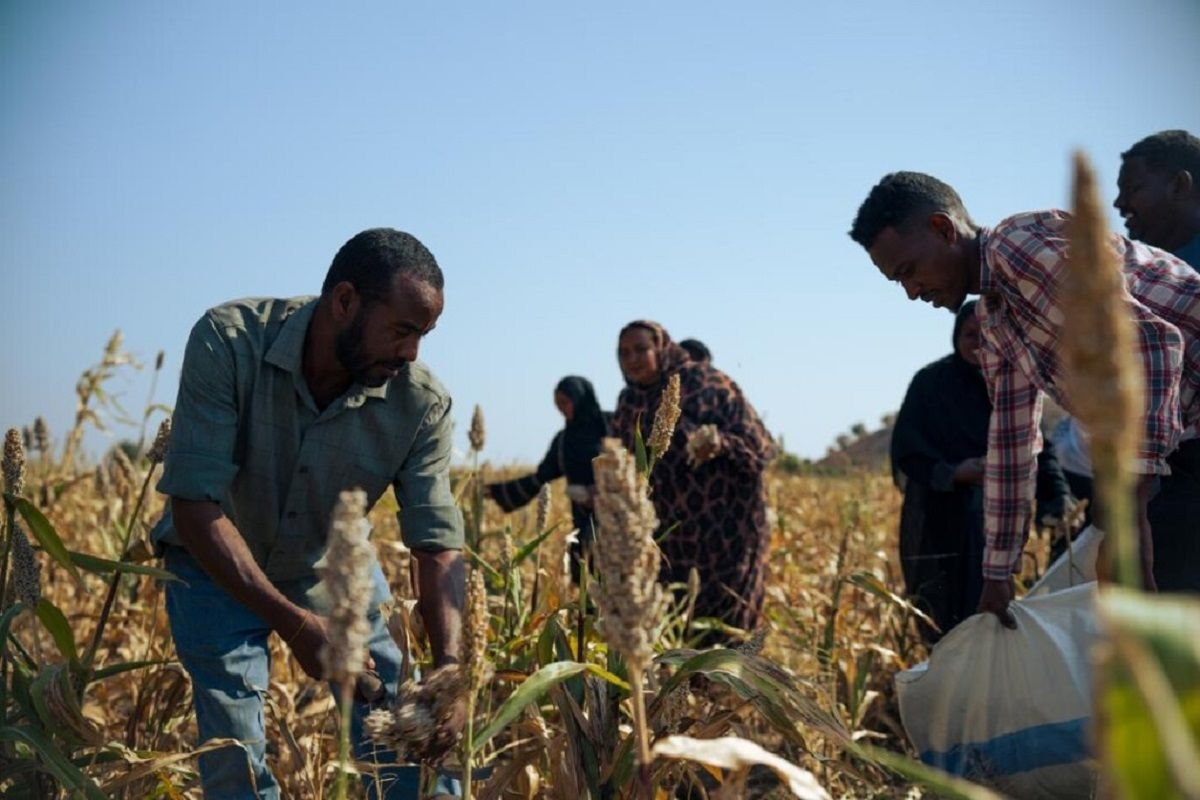
The war has caused severe damage to Sudan’s agricultural sector over the past 35 months. Due to these conditions, the production capacity of projects and agricultural crops has declined by more than half of the total production, according to government reports and specialized studies. Infrastructure also suffered massive losses, including irrigation systems, warehouses, and machinery, as a result of direct fighting and looting campaigns that targeted vital agricultural areas in the states of Gezira, Sennar, Blue Nile, White Nile, and South Kordofan.
In the Gezira Scheme in the center of the country—the largest irrigated project in Africa with an estimated area of about 2 million acres (about 8,400 square kilometers)—the area planted with wheat and corn decreased from 800,000 acres (about 3,360 square kilometers) before the outbreak of the war to about 300,000 acres (about 1,260 square kilometers), with a production of only 150,000 tons. Meanwhile, corn production and contract farming decreased by 16 percent in the Rahad Scheme. The Suki agricultural project recorded the highest rate of destruction and sabotage, as its production dropped from 150,000 tons of corn to only 20,000 tons.
Consequences of the War
In this context, Badr al-Din Ahmed Saleh, a former consultant to the Sudanese Ministry of Agriculture, considered that the current crisis of declining agricultural production is not just a shortage of rain or due to the effects of climate change, but is a direct result of the almost complete paralysis that hit the backbone of the Sudanese economy following the outbreak of the war.
He pointed out that more than 60 percent of the area of the Rahad and Suki projects is out of service, in addition to the paralysis that affected the rain-fed agriculture sector in the five Darfur states and the three Kordofan regions, as well as the displacement of thousands of farmers due to the escalating pace of battles and lack of security.
Saleh predicted that things would get worse as the war approaches its fourth year, with the Kordofan and Darfur states exiting the production cycle, along with a decline in production in the central, northern, and eastern regions.
He noted that the greatest danger lies in the stoppage of the Gezira irrigated project—the largest in the world—after military operations targeted the irrigation infrastructure and seed warehouses, making wheat cultivation in the heart of Sudan a risk-filled adventure. The agricultural specialist warned of the danger of green spaces turning into deserted arenas or isolated areas due to the armed conflict.
Losses and Decline
For his part, Saad Hussein, a member of the Gezira and Managil Farmers Alliance, said that despite the state’s security stability, agricultural activity has not regained its previous level and production capacity has declined extensively. The area for wheat and corn cultivation fell from 800,000 acres before the war to about 300,000 acres, with a production of only 150,000 tons.
He added that the infrastructure of the Gezira Scheme suffered heavy losses, including irrigation systems, warehouses, and machinery, in addition to the lack of necessary financing and improved seeds, fertilizers, pesticides, and inputs, as well as fuel shortages and high prices.
Hussein explained that the war distracted the state from attending to the agricultural sector, which was relied upon to improve the food security situation in the country, leading to a shrinkage of cultivated areas and a decline in the economic feasibility of both rain-fed and irrigated agriculture.
A Large Gap
In the projects of the Habila area in South Kordofan State, western Sudan, attacks by the Rapid Support Forces and its ally, the Sudan People’s Liberation Movement-North led by Abdelaziz al-Hilu, caused instability in the agricultural season. The security situation contributed to the deterioration of the sector in a way that made farmers reluctant to practice agricultural activity, and anxiety and fear gripped citizens for fear of death.
In this regard, Adel Abdel-Qader, a member of the South Kordofan Farmers Union, pointed out that estimates indicate a large food gap resulting from the reduction of the agricultural area, and several localities in the region exiting the production cycle due to the security situation and the fuel crisis following the closure of main roads and the failure of hundreds to reach agricultural projects during the rainy season.
Abdel-Qader warned that the exit of 60 percent of the state’s land from the production cycle raised fears among residents of a famine in the coming months, noting that high fuel prices and its unavailability were the main factors that broke the backs of the farmers.
Pivotal Role
On the same level, agricultural specialist Abbas al-Khalifa explained that agricultural activity in active conflict zones, such as the five Darfur states and the three Kordofan regions, declined significantly as a result of escalating battles and violations, in addition to road closures and lack of security, which contributed to exacerbating food crises and accelerating cycles of poverty and displacement.
Al-Khalifa stated that recovery attempts in states such as Gezira, Sennar, and White Nile intersect with a heavy legacy of war that weakened the production base and squandered the assets of thousands of farmers, especially small producers in the rain-fed and irrigated sectors.
He continued: “Abundant agricultural production this year in the states of Gedaref, Kassala, and Blue Nile represents important signals that agricultural activity has not been completely broken, and that the sector still retains its latent ability to play a pivotal role in restarting the economy if support is well-directed.”
Positive Indicators
In the same vein, economic affairs specialist Al-Zubair Al-Nour said that any country experiencing war inevitably suffers its repercussions, whether in declining agricultural production or reducing areas, especially since these are inevitable economic consequences in light of the continued armed conflict. However, there are positive indicators, especially the abundant production in several cities and regions, including Gedaref, Halfa, Kassala, and the Northern State.
Al-Nour added: “85 percent of the area of the Gezira project and more than 95 percent of the area of the Managil project were cultivated, and this season is witnessing significant productivity in irrigated or rain-fed projects sufficient for Sudan’s needs and providing its food security.”
Emergency Plan
In a related context, the Food and Agriculture Organization of the United Nations (FAO) revealed its need for $230 million to implement a two-year emergency plan to support 12.4 million Sudanese.
It pointed out that the emergency and resilience plan for 2026 through 2028 seeks to support 12.4 million people with funding amounting to $230 million, of which $75 million is needed urgently to implement life-saving agricultural interventions for 7.5 million individuals.
The organization stated that agriculture, which is the cornerstone of Sudan’s economy, is the primary source of food and income for the majority of rural households, as 65 percent of the population works in agricultural activities and it contributes 25 percent to the GDP.
FAO explained that Sudan is not self-sufficient in food due to the difficulties facing cereal production, as production in the 2025 season reached about 5.2 million tons, representing a 22 percent decrease compared to 2024 and 19 percent less than the five-year average.
Agriculture in Sudan
The agricultural sector is one of the largest economic sectors in the country, contributing with its two branches to about 44 percent of the total national product.
More than 60 percent of Sudan’s population depends on sorghum and millet, at a time when the area of traditional agriculture is estimated at approximately 20 million acres (about 84,000 square kilometers), concentrated in the west, south, and parts of the center.
These areas contribute about 90 percent of millet, 48 percent of peanuts, 28 percent of sesame, 11 percent of sorghum, and 100 percent of gum arabic, along with some other crops.