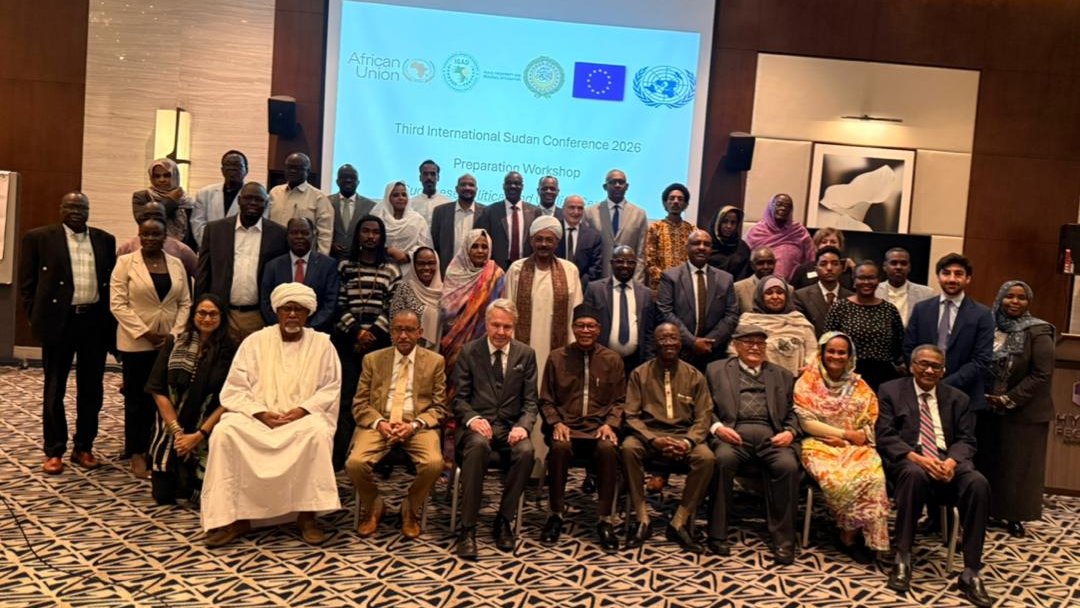
Berlin is set to host an international conference tomorrow (Wednesday) focused on the Sudanese crisis, aiming to support the peace process, reconstruction efforts, and coordination of humanitarian aid for those affected by conflict and displacement. The event will bring together a broad range of Sudanese political and civil actors, as well as independent figures.
Millions of Sudanese hope the conference will succeed in mobilizing international and regional support, particularly in humanitarian assistance, and possibly contribute to ending the war between the Sudanese Armed Forces and the Rapid Support Forces, which has been ongoing for three years. There are also hopes that it will increase pressure on both sides to return to a civilian-led political path.
A major opportunity
In this context, Dr. Abdalla Hamdok, former Prime Minister of Sudan and head of the Civil Democratic Alliance of the Revolution Forces (“Sumoud”), described the Berlin ministerial meeting as “an opportunity to move the process forward.”
He added that the meeting should be used to unify international efforts and channel political will into an effective mechanism for achieving peace. Hamdok stressed the importance of linking the various initiatives led by the African Union, IGAD, the Arab League, the United Nations, and the European Union under a single coordinated roadmap, noting that fragmented mediation efforts weaken the chances of ending the war.
He further explained that a unified international stance in Berlin could accelerate progress—from securing a ceasefire, to delivering humanitarian aid, and ultimately launching a civilian-led political process.
A critical turning point
For his part, Misbah Ahmed, a leader in the Sudanese National Umma Party, described the upcoming meeting as a “critical turning point” in supporting international efforts to address Sudan’s crisis amid worsening humanitarian, political, and security conditions.
He emphasized that the conference aims to mobilize effective international support to end the conflict, focus on humanitarian relief, and promote a comprehensive peaceful solution that restores stability and paves the way for a democratic civilian transition.
Ahmed warned that the consequences of the war have extended beyond Sudan’s borders, posing a direct threat to regional and international peace and security, with risks of broader conflict, instability, and even state fragmentation.
The need for real support
Meanwhile, African affairs researcher Mohamed Torchain noted that similar conferences previously held in Paris and London failed to produce meaningful progress, particularly in addressing the deepening humanitarian crisis.
He pointed out that the United Nations has estimated urgent humanitarian needs in Sudan at around $1.7 billion, with hundreds of thousands of Sudanese refugees in neighboring countries such as Chad, South Sudan, Uganda, and Ethiopia, in addition to massive internal displacement.
Torchain stressed that the success of the Berlin conference depends on whether countries fulfill their financial commitments made in previous meetings. Without that, it risks becoming another ineffective gathering—especially if global crises divert attention and resources.
Full support and expectations
In a related statement, the Civil Democratic Alliance (“Sumoud”) reaffirmed its support for all peace efforts and its constructive participation in the Berlin meetings. It emphasized the importance of reaching a broad civilian consensus on ending the war and building sustainable peace.
The alliance expressed hope that the conference would lead to tangible outcomes, including:
An immediate and unconditional humanitarian ceasefire across Sudan
Effective mechanisms to protect civilians
Guaranteed access for humanitarian aid without interference
Adequate funding to close the humanitarian response gap
The statement also highlighted the need to integrate three parallel tracks within a unified peace process: humanitarian action, ceasefire arrangements, and inclusive political dialogue—leading toward a just and lasting peace in Sudan.