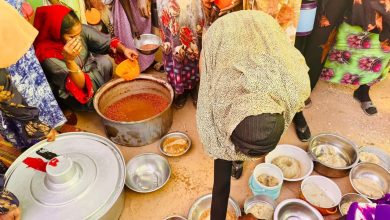
As the war enters its fourth year, the humanitarian situation for millions of Sudanese has worsened due to a deepening food crisis affecting many cities and states, most notably Khartoum, Al Jazirah, Sennar, Kordofan, and Darfur.
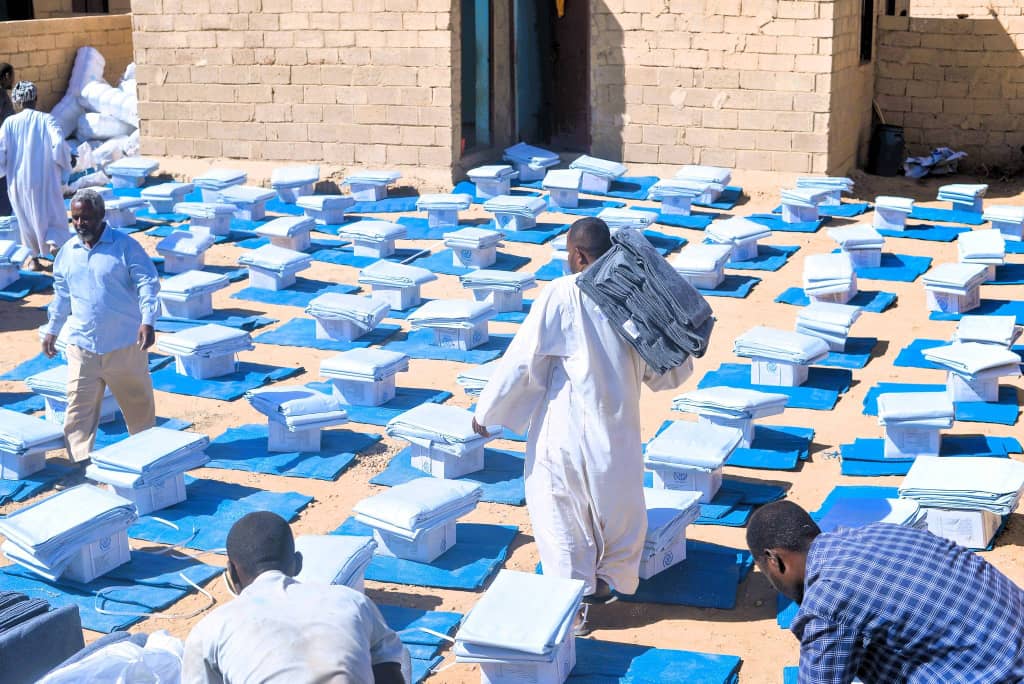
Meanwhile, the city of Port Sudan, the capital of the Red Sea State, continues—through its port and airport—to receive large quantities of humanitarian aid provided by several countries for distribution to those affected in conflict and displacement areas. These supplies include food items and life-saving medicines.
A Shocking Reality
Despite the severe conditions faced by millions, chaos has overtaken these aid supplies, with reports of looting and diversion into markets—even under strict security measures. Quantities have been found openly sold in shops, still bearing donor country logos on cardboard boxes.
Amer Al-Tayeb, a shop owner in Port Sudan, told Mashawir:
“Indeed, the city’s markets are filled with relief supplies in large quantities. As a trader, I used to purchase goods from wholesalers, but recently I’ve been buying these aid items displayed on the ground or inside shops in the main market. They include everything people need in their daily lives.”
He noted that these goods are sold at high prices, especially flour, sugar, and powdered milk, due to their high quality. This has led many customers to repeatedly request them, with some even placing advance orders and payments when supplies run out.
He added that the diversion and public sale of these materials have angered citizens, who believe they should have gone to displaced people and those in conflict zones instead of being sold in such an inappropriate and unethical manner.
Violation of Citizens’ Rights
Sudanese citizen Salma Hamad called for an investigation into the aid supplies entering the country and the incidents surrounding them, asking:
“How did they reach the markets? Who benefits from selling them?”
She told Mashawir that she had spent several days in Khartoum and personally saw relief supplies being sold in markets, where traders confirmed they came from eastern Sudan.
She described the looting and theft of aid as a clear and blatant violation of citizens’ rights, noting that these supplies were originally intended to save lives and help people cope with hunger, disease, and epidemics worsened by the war.
Silence from Officials
Amid these developments, a committee had been formed in the Red Sea State to oversee humanitarian aid operations. However, the situation has led officials to remain largely silent, refusing to provide information about the quantities received, how they were transported and stored, which groups were targeted, and how the supplies were looted or diverted despite security measures.
These unanswered questions have been met with notable silence from Sudanese authorities, suggesting reluctance to fuel further tensions at a time when the country faces a critical situation.
Aid Diversion Chain
Al-Fadil Hassan, a volunteer in displacement camps in eastern Sudan, told Mashawir:
“In many cases, aid boxes do not reach the tables of the hungry. Instead, they follow a different path—from overcrowded camps to parallel markets. This chain involves overlapping actors, each trying either to survive or make a profit.”
He added:
“Relief supplies are no longer just a means to feed the hungry; they have become a traded commodity forming a parallel market with its own rules. Prices are determined by supply and demand, benefiting many traders, while the poorest remain the biggest losers.”
Retailer Hussein Ashraf in Port Sudan confirmed:
“We receive boxes of aid stamped with donor names and labeled ‘Not for Sale,’ but people no longer pay attention to that. Demand is high because they are cheaper than imported goods, and the average consumer does not ask about their source.”