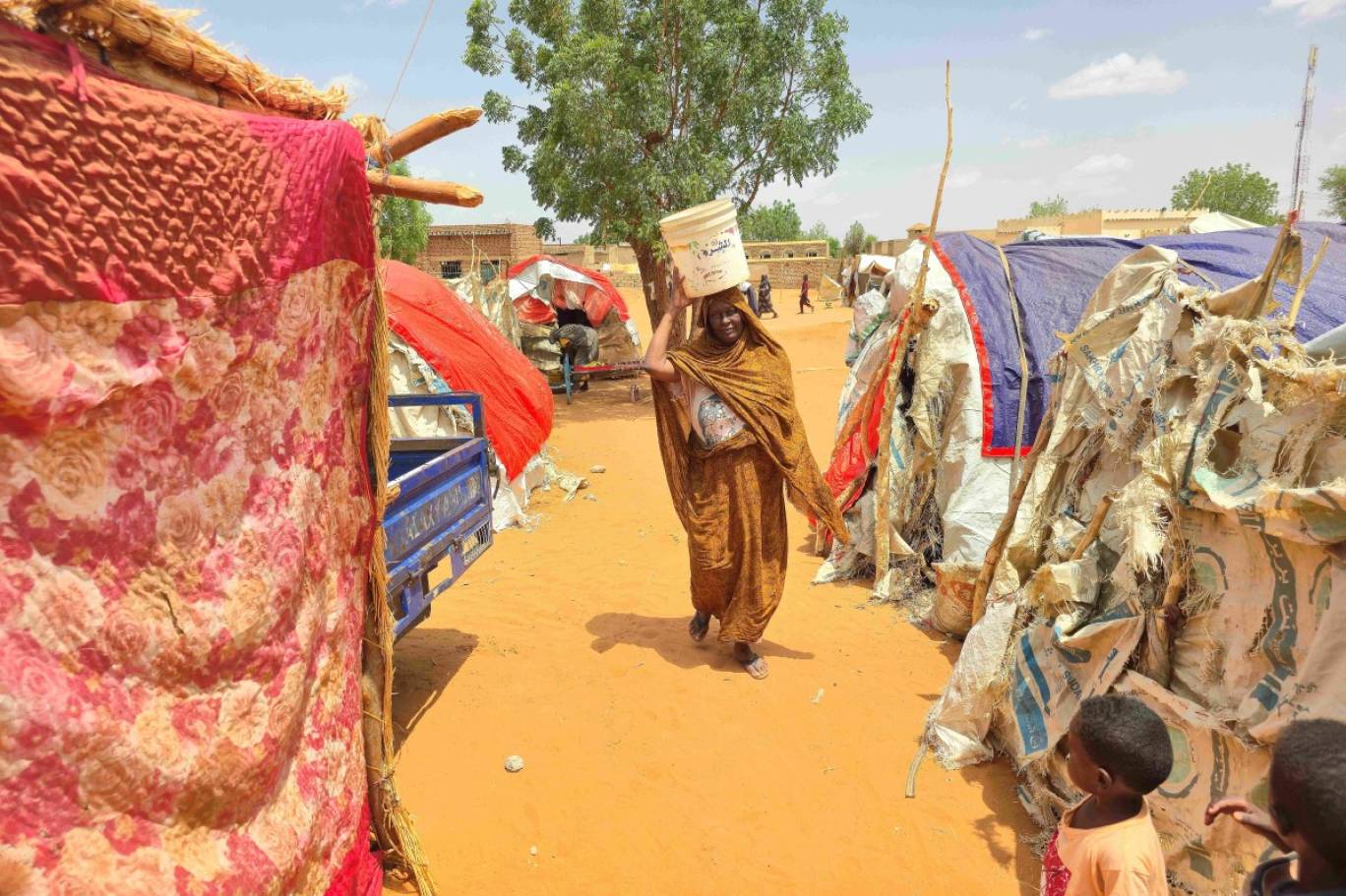
Since drone attacks knocked out electricity, fuel, and water facilities in El Obeid, the capital of North Kordofan in Sudan, Aqsam Mohamed has been making a long daily journey under the scorching sun to collect murky water from a distant well.
In recent weeks, the Rapid Support Forces (RSF) have intensified drone strikes on El Obeid, targeting civilian infrastructure, electricity and fuel facilities, and highways leading out of the city. The military buildup around the city has drawn comparisons to the period preceding the assault on El Fasher in North Darfur late last year—an attack that UN experts said bore characteristics of genocide.
Multiple Crises
Mohamed, who lives with her seven children in Al-Rahmaniya Camp on the outskirts of El Obeid, said:
> “We walk long distances carrying water on our heads, even though it is not fit for drinking.”
With water stations rendered inoperable, residents now depend on wells, water tankers, and a limited number of distribution points.
The 35-year-old added:
> “We have no assistance at all. We need water and food.”
El Obeid, a city with an original population of around 500,000, is now also sheltering approximately 100,000 displaced people who fled violence in neighboring areas. It occupies a strategic route linking Darfur, where the RSF controls large areas, with central and eastern Sudan under army control.
Military Reinforcements
Last week, the UN Security Council expressed concern over the “large-scale military buildup by the RSF around El Obeid,” warning of the risk of imminent mass atrocities.
Nihad El-Tayeb, a researcher with the Armed Conflict Location & Event Data Project (ACLED), said RSF troop movements had been observed over the past month approximately 60 kilometers north, south, and west of the city.
Analysts believe that capturing El Obeid would significantly strengthen RSF control over western Sudan and could pave the way for an advance toward the capital.
The city hosts an army infantry division, an air base, a major oil pipeline, and one of Sudan’s largest gum arabic markets, making it both strategically and economically important.
According to Sudan analyst Kholood Khair, control of El Obeid is fundamentally about “power, land, and money.”
Everything Is in Crisis
Ongoing fighting, blocked roads, and movement restrictions have made independent verification of conditions in the city extremely difficult.
Rare footage filmed by an Agence France-Presse (AFP) correspondent at Al-Rahmaniya Camp shows exhausted women walking slowly beneath the blazing sun, balancing plastic water containers on their heads after waiting for hours at a well.
Around 200 families live in makeshift shelters built from straw, torn fabric, and plastic sheets. Children spend their days under the limited shade of the huts; some appear too exhausted to play, while others silently follow their mothers.
Inside one of the shelters, Waseela Mohamed, 70, said:
> “We have nothing—no water, no food, and no bedding.”
Needs Far Exceed Available Aid
Humanitarian and food supplies reaching the camp have declined sharply in recent weeks because of road closures and damage to infrastructure.
A humanitarian volunteer said that “needs far exceed available supplies,” stressing the urgent demand for healthcare and food assistance.
Across El Obeid, the constant buzz of drones has become part of daily life.
“No one knows what will happen next,” said Adam Hussein, who requested a pseudonym for security reasons.
After a drone crashed near him without causing injuries, he said:
> “Everything in El Obeid is in crisis. Civilians and civilian infrastructure are being targeted continuously.”
Kholood Khair noted that many residents are now effectively trapped, as water prices have doubled, food costs have risen by as much as 300 percent, and transportation costs have surged.
“Many people have not left because they simply cannot afford to, or they have nowhere to go,” she said.
Approaching a Complete Siege
Mohamed Refaat of the International Organization for Migration (IOM) warned that El Obeid is approaching a complete siege, leaving civilians “soon unable to leave safely or return safely.”
He said humanitarian organizations have suspended operations because of the deteriorating security situation and limited access, while humanitarian needs have exceeded pre-positioned emergency supplies.
Without immediate assistance, Refaat warned, conditions in El Obeid could within weeks resemble those experienced in El Fasher, where civilians survived an 18-month siege largely by relying on animal feed.
According to UN estimates, more than 6,000 people were killed during the first three days following the fall of El Fasher, and Western governments have warned of similar atrocities if El Obeid were to fall.
A government source told AFP that the Sudanese army had attempted to slow the RSF advance and destroyed some of its military equipment during movements last week.
An RSF-affiliated source, however, accused the army of using civilians as “human shields,” arguing that they should have been evacuated.
Although El Obeid’s demographic composition differs from that of El Fasher, where violence took on a pronounced ethnic dimension, Nihad El-Tayeb warned that civilians in El Obeid could still face widespread looting, sexual violence, and attacks against individuals accused of supporting the Sudanese army.