On the fateful morning of Saturday, April 15, 2023, Mayada Al-Sadiq, 12, had no idea that it would be her last day at school. As usual, she woke her mother early to help her prepare her school uniform and bag and review some of her lessons. She dreamed of becoming an engineer, just like her mother.
But suddenly, that morning routine came to an end. Her schoolbag was no longer filled with books and notebooks. Instead, it carried a few hastily packed clothes, as she fled in fear from the sounds of gunfire, explosions and artillery shelling that filled the skies over the capital, Khartoum, with rising columns of smoke, signalling the beginning of the war between the Sudanese Armed Forces and the Rapid Support Forces (RSF).
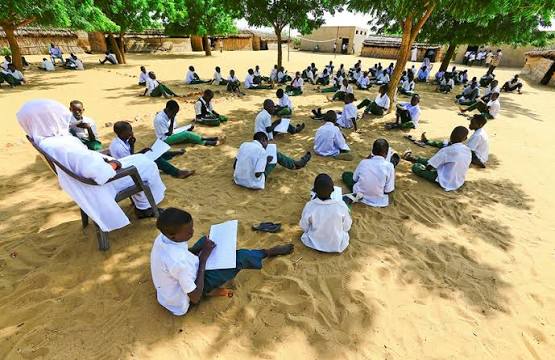
Her fate was a small room in one of the displacement schools in Wad Madani, the capital of Gezira State, which had opened its doors to receive people fleeing Khartoum. Her dreams were shattered as she found herself without a school. Sometimes, she would hold a pen and draw silent shapes on the palm of her hand, reflecting the loss of her future.
Mayada’s story is just one among millions left behind by the war in Sudan, where the basic features of normal life are disappearing before children’s eyes, foremost among them education.
The catastrophe facing education has gone beyond the destruction of schools and the suspension of salaries. It has deprived an entire generation of one of its most basic rights, amid an almost complete absence of intervention or an urgent rescue plan. Teachers themselves have been scattered: some are displaced and dependent on humanitarian assistance, while others remain in areas under bombardment, struggling every day to survive.
Alarming Figures
United Nations organisations have documented the collapse of education in Sudan. In October 2023, the United Nations Sustainable Development Group issued an early warning, confirming that the country was on the brink of becoming the world’s worst education crisis. At the time, approximately 19 million children were out of school, including seven million who had already been deprived of education before the war because of poverty.
In September 2024, the United Nations Children’s Fund (UNICEF) issued a statement highlighting the tragedy of more than half of Sudan’s children being deprived of education. It reported that 17 million school-age children remained outside classrooms, while 90 per cent of schools across most states were completely closed, largely because they had been converted into shelters for displaced people or military barracks. Others remained open only on a limited scale.
Meanwhile, Save the Children, in a report issued on January 22 this year, indicated that millions of children had lost approximately 500 days of continuous education in one of the world’s longest school-closure crises, surpassing the disruption caused by the COVID-19 pandemic. The organisation confirmed that more than eight million children had stopped attending school altogether and that 55 per cent of schools were closed.
Similarly, the Global Partnership for Education, in a report issued in February 2026, noted that thousands of schools had been transformed into military barracks, operational bases or shelters for displaced people. In the Darfur region, only three per cent of schools remained open.
Catastrophic Conditions
Alongside these UN figures, the Sudanese Teachers’ Committee has provided a detailed field-based and critical assessment reflecting the catastrophic state of the education system and the conditions facing teachers, shedding light on details often missing from published reports.
In this regard, Sami Al-Baqir, spokesperson for the Sudanese Teachers’ Committee, said: “Since the outbreak of the war, teachers’ conditions have become catastrophic, with negative economic and social consequences. This has forced hundreds of them to seek alternative, marginal jobs far removed from the teaching profession, further draining the remaining public schools of their qualified teaching staff.”
Al-Baqir added: “These conditions have left around 350 teachers and administrative staff in the education sector facing an uncertain future following the suspension of their monthly salaries. Among them are patients who cannot afford medical treatment and widowed female teachers supporting their families. All of them are also facing forced displacement without salaries, particularly as teachers are now living below the extreme poverty line, with more than 50 per cent not receiving their regular salaries.”
He continued: “Even when teachers receive their entitlements, these payments cover only three per cent of their families’ monthly needs, exposing the depth of the crisis facing Sudanese teachers. This also reveals the government’s inability to meet its obligations towards the country’s education system and implement its official decisions and directives concerning teachers’ rights.”
Al-Baqir pointed out that, despite decisions and assurances from the country’s senior authorities, teachers’ entitlements remain suspended, while other payments have not been fully implemented in several states.
He explained that “the fact that new directives are now being requested to implement previous decisions reveals serious shortcomings in state administration and a lack of coordination among its institutions. This raises an urgent question: Which authority is obstructing the implementation of these decisions, and who is holding it accountable?”
He warned that “this crisis extends beyond teachers themselves to threaten the continued operation of schools and the quality of education. It is also forcing teachers to seek alternative sources of income at a time when school dropout rates and learning losses are increasing, leaving more than eight million children out of school.”
He noted that the Sudanese Teachers’ Committee is demanding an increase in the minimum wage, payment of all outstanding salaries and entitlements, guarantees of regular salary payments, and measures to address disparities between states.
He further stressed that the continued deterioration of public education is inseparable from the failure of government policies to provide the necessary funding for this devastated sector, protect schools and fulfil the financial obligations already approved by the state.
He questioned: “How can anyone talk about education reform when teachers cannot afford to meet their families’ basic needs, most schools remain out of service, and millions of children are denied their right to education?”
The spokesperson for the Sudanese Teachers’ Committee explained that the committee’s vision is clear. It calls for the state to fully resume its responsibility for public education, allocate 20 per cent of the national budget to education, guarantee free education, reform the salary structure, ensure regular payment of salaries, rehabilitate schools, address school dropout, and support children affected by war and displacement.
He warned that continuing with the current approach threatens to undermine public education in favour of private education, transforming quality education from a right available to every child into a privilege reserved for those who can afford it.
“Therefore, saving education begins with saving the teacher and ensuring that the state fully assumes its responsibility towards this sector.”