Before Mustafa Ahmed Mustafa took on the duty of watching over the Pyramids of Meroe in Sudan, a long line of guardians had held the role. Today, however, he stands almost alone at the site, three years after war broke out between the Sudanese army and the Rapid Support Forces.
The 65-year-old man, standing among the dark sandstone structures of the Bagrawiyah necropolis on Meroe Island—listed as a UNESCO World Heritage Site—said: “These pyramids belong to us. They are our history. They are our identity.”
The 2,400-year-old site includes around 140 pyramids built when Meroe was the capital of the Kingdom of Kush. Today, many of these pyramids are no longer intact. Some have lost their tops, while others have turned into rubble—first due to 19th-century treasure hunters who used explosives, and later from two centuries of wind and rain erosion.
Located about three hours by car from Khartoum, the site was once Sudan’s most visited archaeological attraction. Now, after three years of war, silence dominates—broken only by the sound of a lone camel.
Archaeologist and site director Mahmoud Suleiman explained to AFP the matrilineal succession system of the Kingdom of Kush, its trade routes, and its relationship with neighboring Egypt. He said: “This is perhaps only the fourth time since the war began that I’ve guided visitors.”
Suleiman, along with Mustafa and young archaeologist Mohamed Mubarak, works with limited resources to protect the pyramids from erosion caused by rain and sand. Aside from a brief uptick in visitors early in the war, the site has remained largely abandoned.
“My Grandmother Kandaka”
The scene today is vastly different from before the war, when regular weekend trips from Khartoum brought around 200 visitors daily. Suleiman noted that Sudan’s archaeological sites saw renewed interest after the 2018–2019 , when protesters chanted: “My grandfather is Taharqa, and my grandmother is Kandaka.”
Taharqa was a ruler of Kush, while “Kandaka” referred to ancient queens and later became a symbol honoring women of the
Local residents of nearby Trabail village—whose name locally means “pyramids”—once depended entirely on tourism, selling souvenirs and renting camels. Among them is Khalid Abdel Razek, who rushed to the site upon hearing of visitors, offering small sandstone pyramid replicas he crafted himself, recalling the days when “dozens of us used to sell here.”
In the months before the war, the site hosted documentary film crews, a music festival, and “big plans” for after Eid al-Fitr. But all of that vanished when conflict erupted in the final days of Ramadan. Mubarak, who has worked at the site since 2018, said: “I used to feel I was introducing people to their culture. Now, of course, people’s top priority is food, water, and shelter. But this matters too—we must protect it for future generations.”
A Distant Dream
Near the site entrance, pyramids rise prominently, each preceded by a small funerary temple, set against a landscape of layered black sandstone hills. Though the view is striking, Suleiman says he sees only threats—cracks in structures, shifting , and the need for reinforcement before the rainy season.
The largest pyramid, belonging to Queen Amanishakheto (1st century CE), has suffered severe damage. In 1834, Italian adventurer Giuseppe Ferlini destroyed dozens of pyramids, including hers, in search of treasure. He leveled the structure and transported its
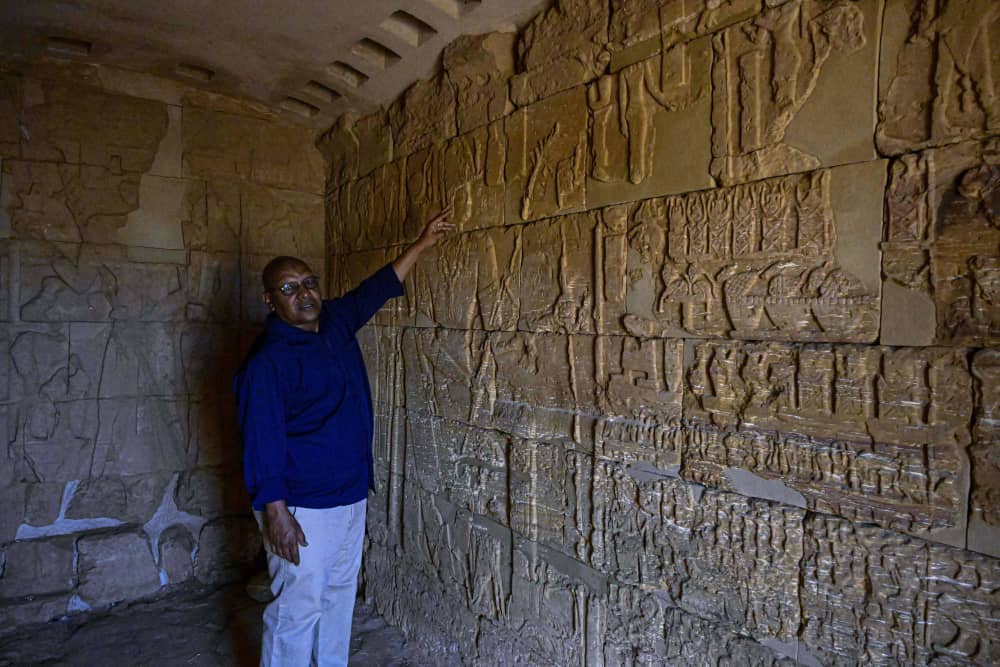
Parts of her temple wall still stand, showing a relief of the queen larger than life, holding a spear and striking enemies. Suleiman also highlighted carvings of Apedemak, alongside shared motifs with Egyptian culture such as Amun and Anubis, as well as lotus flowers and hieroglyphs.
Suleiman hopes for the day when tourists and archaeologists return. “It may be a distant dream,” he said, “but I truly hope we can one day carry out proper restoration of these pyramids. This place holds immense potential.”