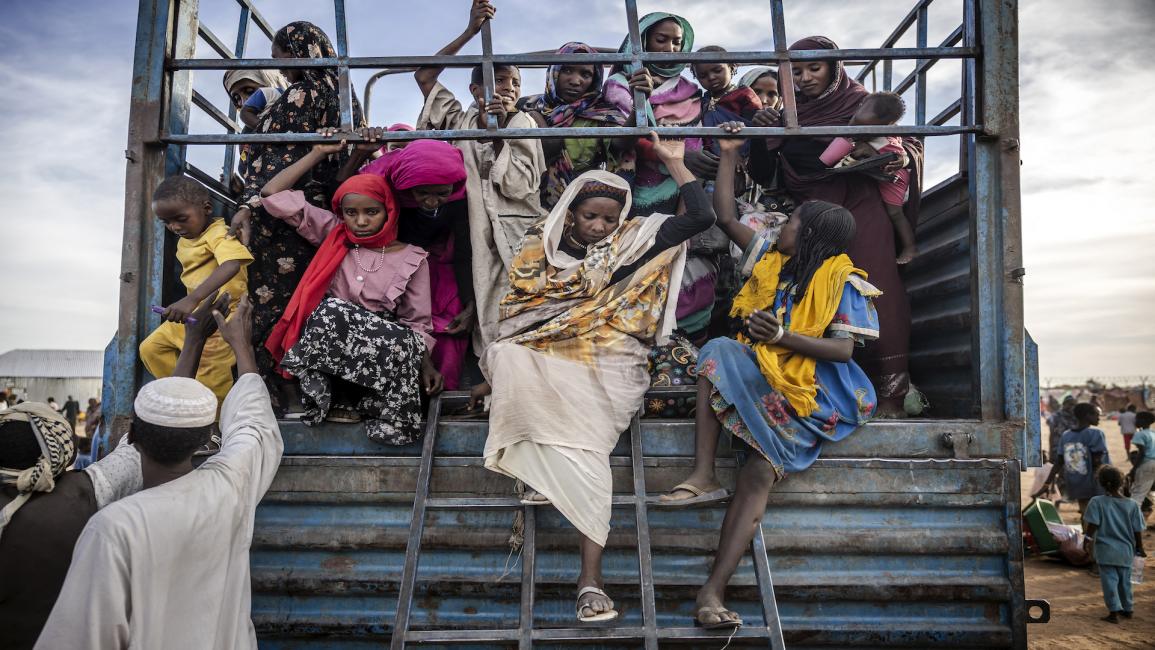
As Sudan’s war enters its fourth year, the number of forcibly disappeared persons and detainees has increased dramatically, while their families endure severe psychological suffering due to the mysterious disappearance of their loved ones, especially as both sides of the conflict refuse to disclose the fate of those held in unofficial detention centers.
With the expansion of the war, the number of missing persons in illegal prisons run by the Rapid Support Forces, as well as the Sudanese army, has risen sharply, raising concerns among families, lawyers, and activists over the fate of thousands of civilians, particularly after dozens of deaths were reported in secret detention sites.
Psychological Suffering
The International Committee of the Red Cross (ICRC) stated that at least 11,000 people have gone missing in Sudan since the outbreak of the war three years ago, representing an increase of more than 40 percent during the past year alone. The organization pointed to the “deep and ongoing psychological suffering” experienced by thousands of families who “continue to wait for news of loved ones separated from them while fleeing the fighting.”
James Reynolds, Deputy Regional Director of the ICRC, said that “these figures, which likely represent only a fraction of the true numbers, demonstrate the human cost of prolonged conflicts such as this one,” noting that “shifting frontlines have displaced more than 11 million people, some of them multiple times.”
The ICRC added that among them, four million people fled the country, stressing that the destruction of many communication networks caused “countless families to lose contact with their loved ones,” leaving them with uncertainty about their fate and causing “deep and ongoing psychological suffering.”
The committee also stated that it had helped hundreds of families reconnect with relatives, explaining that Red Cross and Red Crescent societies in Sudan facilitated more than 560,000 phone calls in 2025, as well as in Egypt, South Sudan, and Chad, in addition to resolving 1,100 disappearance cases.
Ransom and Disappearance
In the same context, Jaafar Bakhit said he lost three family members while attempting to flee the city of Al-Nuhud in West Kordofan State in December 2025, especially after grave violations against civilians escalated.
“Since that day, we have been searching for them by posting their photos on social media, but we have not found any clue leading us to them,” he said.
Bakhit added: “We are living through the tragedy of loss, and we have found nothing indicating where they are being held since we fled West Kordofan and became displaced in shelter camps in El-Obeid, the capital of North Kordofan State. We hold the Rapid Support Forces responsible for the safety of our brothers because they are involved in illegal detention and arrest operations against civilians in the region.”
He explained that “women and children were also detained, while phones were confiscated for blackmail purposes. Families are now forced to cut from their daily food just to pay ransom for their loved ones, only to later discover that both the kidnappers and detainees have vanished.”
Arbitrary Arrests
Meanwhile, Al-Tahami Ismail, brother of another missing man named Faris, said: “My 23-year-old brother went on February 12 to buy daily necessities for the family from the market in Wad Madani, the capital of Al Jazirah State, but he was gone for a long time. We tried calling him, but his phone was switched off.”
“As time passed, our concern grew until night fell, and the situation became alarming. We went to police stations but could not find him. We returned home overwhelmed by fear and despair,” he added.
The following day, the family received a call from one of his friends informing them that he had been arrested by a force affiliated with the Sudanese army.
“After that, we knocked on every door trying to identify where he was being held, but we could not obtain any information about him,” Ismail said.
He continued: “Many families in areas controlled by the army are living under extremely difficult psychological conditions because of the disappearance of their children, as arbitrary arrests are carried out merely on suspicion, particularly in cities and areas of Al Jazirah State.”
Difficulty in Communication
Zahra Al-Sanousi, who was displaced to White Nile State, recounted that “members of the Rapid Support Forces arrested her son and brother in the Al-Debibat area of South Kordofan State in August 2025, and since then she has received no news about them or their place of detention.”
She noted that some family members risked traveling to Al-Debibat, Abu Zabad, and Al-Fula — areas under Rapid Support Forces control — in search of them, without success, despite paying money in attempts to access detention sites.
Al-Sanousi stressed that “Sudanese families are suffering enormously from the disappearance of their relatives and from worrying about their unknown fate — whether they are alive or dead — while being unable to communicate with them.”
Unknown Fate
Human rights lawyer Haider Younis said that “security authorities in army-controlled areas have continued carrying out unlawful arrests, while the fate of hundreds of detainees remains unknown, in addition to the absence of mechanisms to search for missing persons and verify detention locations.”
He pointed out that “most families of missing persons in areas controlled by the Sudanese army face major difficulties in identifying detention centers and prisons, and there is no authority they can communicate with on this issue other than legal groups and human rights activists.”
The lawyer further warned that “dozens of young men in cities such as Port Sudan, Atbara, and Gedaref were stopped in public roads and shops and taken to unknown destinations. Their fate remains unknown, and no information has yet emerged about them.”
He added: “On the other side, there are thousands of missing persons in Rapid Support Forces-controlled areas, including civilians and former military personnel arrested on accusations of collaborating or communicating with the army. Their families are suffering psychologically because of these mysterious disappearances.”
Weak Monitoring Mechanisms
Human rights activist and member of the “Missing” initiative, Namarq Al-Tijani, said that “the number of forcibly disappeared persons and detainees is likely very high. As fighting spread across wider areas, volunteers witnessed increasing violations, while the weak capacity of organizations in monitoring and documentation further undermined self-tracking mechanisms.”
She added that “many victims’ families contact the initiative, as well as the Darfur Bar Association, and contribute information because they have not yet lost hope of finding their loved ones.”
Al-Tijani noted that “the collapse of communication networks and the difficulty of reaching states experiencing armed conflict and controlled by the Rapid Support Forces have hindered efforts to document all cases of enforced disappearance, and the numbers in those areas are likely very large.”
She concluded: “There are also thousands of missing persons in areas controlled by the Sudanese army, and under wartime conditions, human rights organizations and the families of the missing face enormous challenges in determining the fate of thousands of civilians.”