The Al-Mogran area, one of the oldest and most prominent green spaces in Sudan’s capital, Khartoum, is facing the threat of extinction due to the massive destruction it has endured over two and a half years, with little regard for its environmental, scientific, cultural, and recreational significance. The area hosts numerous universities, diplomatic missions, clubs, banks, and foreign organizations, as well as service facilities such as restaurants and event halls.
Al-Mogran holds special importance as its name is derived from the confluence of the Blue and White Niles, where they meet in a majestic and symbolic embrace. It is also one of the country’s historic natural landmarks, home to the National Botanical Garden of Sudan, Al-Mogran Family Park, 6 April Gardens, and several international hotels.
Destruction and Decline
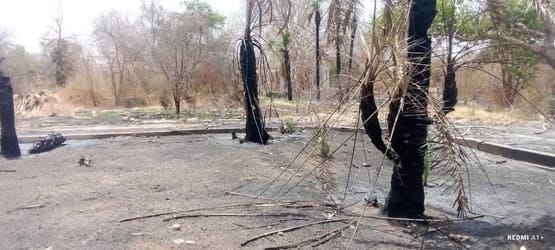
Environmental and urban development specialist Bashir Hamouda laments the dire state of Al-Mogran, which before the outbreak of war in April 2023 was renowned for its beauty, order, lush greenery, and dense tree cover. “Today it is nothing but ruins,” he says, noting that many areas have become barren and desolate.
Hamouda attributes the loss of Al-Mogran’s splendor and the severe destruction it suffered after such a rich legacy to several factors, including deliberate artillery shelling and exchanges of gunfire that wiped out diverse and distinctive groups of trees—particularly in the National Botanical Garden, Al-Mogran Family Park, 6 April Gardens, and the Hilton area. This was compounded by the suspension of maintenance work by supervisors and laborers, as well as the deprivation of irrigation water from the nearby Nile due to the war.
Despite this, the environmental specialist expressed cautious optimism that the extensive efforts being undertaken by the Khartoum State Government will succeed in rebuilding and rehabilitating the Al-Mogran area, especially after specialized committees began implementing a rehabilitation plan for Al-Mogran Family Park, 6 April Gardens, and the Hilton gardens.
Devastation and Neglect
The Sudan National Botanical Garden, one of the oldest green spaces in Africa, has been transformed into a lifeless wasteland due to the armed conflict. Established in 1954 at the confluence of the two Niles, the oval-shaped garden covers an area of 11 feddans and was designed as a green sanctuary and living museum for rare and unique Sudanese plant species. It reflects the country’s climatic diversity and botanical wealth and serves as a gene bank and repository for plant genetic resources.
Agricultural engineer and plant expert Mohamed Farouk said that the garden—one of the most important environmental hubs in the African vegetation belt—has suffered destruction, vandalism, drought, and neglect, with 90 percent of its trees damaged.
He explained that the garden was originally established to conserve and maintain plant genetic resources, cultivate new plant varieties, conduct related scientific research, organize botanical data, and preserve Sudan’s plant biodiversity.
Farouk noted that the war stripped the garden of much of its beauty and legacy built over 67 years, leaving it little more than a signboard pointing to a barren space. Irrigation systems were looted, and water shortages led to the loss of globally rare Sudanese trees such as Al-Marfaein, Redoum sandalwood, and the endemic Dracaena omet, in addition to ornamental plants, seed banks, and genetic stock.
He added that as a result of destruction, water cuts, and indiscriminate tree cutting for cooking fuel, more than 60 percent of the garden’s contents were lost, leaving only 269 trees out of 650, belonging to about 27 plant families.
Looting and Plunder
In a related context, Mohannad Al-Zubair, a member of the Sudanese Horticulture Association, said the war destroyed most green spaces in the Al-Mogran area due to shelling, gunfire, and irregular irrigation—particularly 6 April Gardens (33,000 square meters), Al-Mogran Park, and Hilton Gardens.
He noted that these sites play an important educational and cultural role, traditionally hosting flower exhibitions twice a year—in November and March—which attract large numbers of visitors, including specialists, hobbyists, and families. These exhibitions feature products from nurseries and agricultural companies, gardening equipment, and ornamental birds.
Al-Zubair pointed out that the war also destroyed vital units such as seed collection, propagation, acclimatization, genetic preservation, classification units, research centers, ornamental plant departments, landscaping and heritage sections, documentation and information units, as well as departments for international exchange with botanical gardens and economically important plants. Training facilities for university students and research were also looted and vandalized.
Reconstruction Efforts
Meanwhile, Khartoum Locality announced that several parks and family recreational areas have reached advanced stages of reconstruction and rehabilitation following the destruction caused by the war.
Executive Director of Khartoum Locality Abdelmonem Al-Bashir said the efforts are part of directives issued by the High Committee for Preparing the Environment for Return to the Capital, headed by Lieutenant General Ibrahim Jaber.
For his part, Kamal Awad Al-Karim, Director of the General Administration and Civil Service, confirmed that Khartoum Locality has begun reviewing and overseeing the rehabilitation of all parks, family recreational areas, and tourist sites along Nile Street.
Rehabilitation Initiatives
Officials overseeing the National Botanical Garden hope to overcome the current situation through an initiative launched by a volunteer group of young people interested in agriculture. The group issued a call to rehabilitate and rebuild what the war destroyed in the garden.
Buthaina Mohamed Al-Hassan, Director General of the Horticulture Sector at the Ministry of Agriculture, said the initiative aims to restore the botanical garden to its former state. She noted that the administration has developed a rehabilitation vision that includes presenting the garden’s history and objectives, as well as restoring greenhouses, cold storage units, diverse trees, and plant genetic resources—efforts that require infrastructure and protection for remaining trees.
Initiative member Adel Hamadto said the group has prepared detailed studies to develop the botanical garden, restore the remaining environmental and agricultural heritage, compensate for losses, and introduce new plant and bird species.
Al-Mogran of the Two Niles
The Al-Mogran district was established during the early founding of Khartoum under Khurshid Pasha (1826–1838) during the Turkish rule, which marked a transformation in urban planning by encouraging residents to abandon makeshift huts and straw dwellings in favor of permanent housing, supported by the provision of building materials.
The Al-Mogran of the Two Niles area, from which the historic district takes its name, is distinguished from other neighborhoods of the capital by its fertile soil, lush greenery, and dense tree cover.