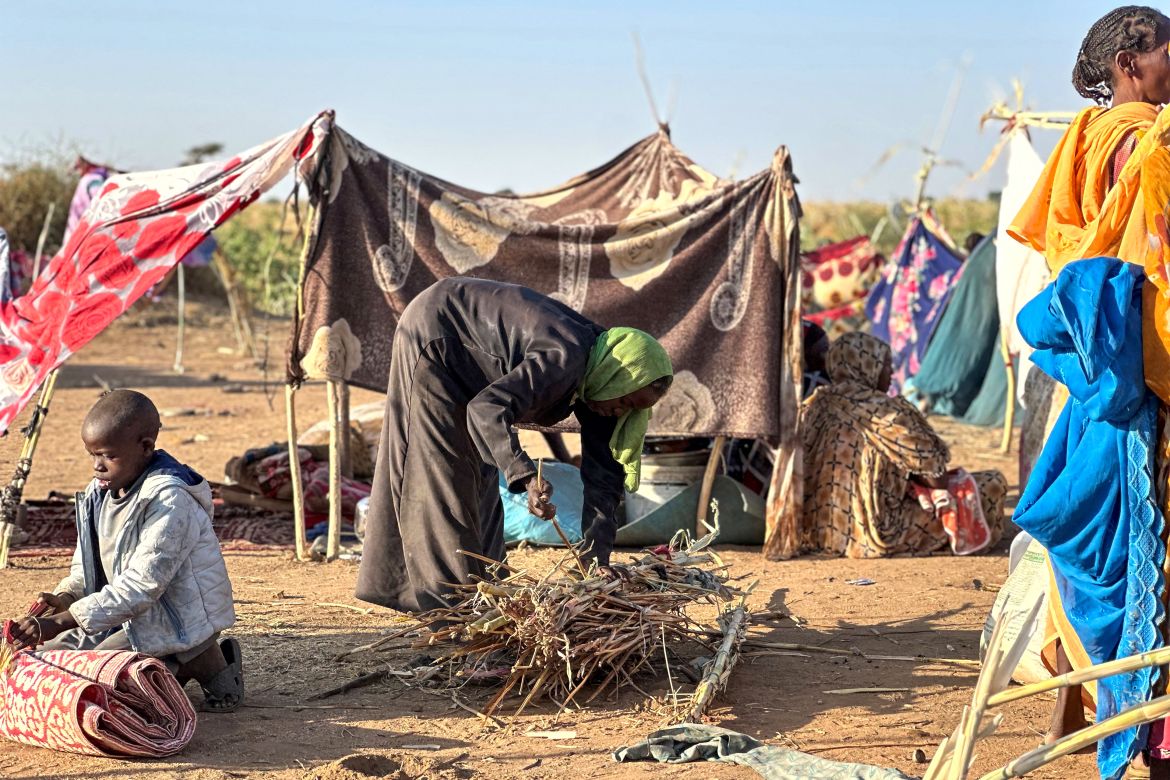
The war raging in Sudan between the army and the Rapid Support Forces for more than 32 months has not only reshaped the balance of power and physical destruction; it has also reconfigured language itself as one of the most dangerous arenas of invisible conflict. Vocabulary of violence has seeped from military statements into everyday discourse, turning words into tools of polarization and exclusion, while hate speech and racism have escalated under the pressure of fear and division.
With the dominance and influence of social media on society, the reproduction and normalization of this discourse have accelerated, leaving a deep impact on collective consciousness and perceptions of the “other.” War is no longer narrated as a transient event; it has infiltrated language itself.
A New Wall
Researcher in language and identity Jamal Nasr al-Din says, “The most dangerous thing wars do is not only direct killing, but their ability to reprogram the language through which people think and speak.” He adds that “the Sudanese scene clearly reveals how military terminology has moved beyond official statements and operations rooms to settle into everyday discourse and even individuals’ emotional language. Words such as ‘sweeping,’ ‘deployment,’ and ‘decisive action’ are no longer technical descriptions but have become tools for interpreting and justifying reality.”
He continues, “This linguistic shift does not occur in isolation from violence; rather, it works to normalize it. Harsh terminology is used casually, dulling its psychological impact and making killing and displacement part of a familiar daily narrative. The deeper problem lies in the fact that when language is stripped of its human dimension, it becomes a means of dehumanizing the other—especially when war terminology is linked to specific social or geographic identities.”
The researcher notes that “this change leaves a long-term impact on collective memory, as generations grow up treating violence as a natural language rather than an exceptional occurrence. Restoring a more balanced discourse does not begin with stopping the war alone, but with dismantling this language and questioning the words we use daily before they turn into a new wall separating Sudanese people and reproducing conflict in different forms.”
Division and Exclusion
As the conflict intensifies, language has ceased to be merely a means of expression and has become a tool of classification and exclusion. Media discourse researcher Abdullah Al-Muhandis explains that “the war in Sudan has blurred the lines between description and incitement. Language used today in the public sphere is no longer neutral; it is loaded with explicit or implicit violence. The most dangerous aspect of this shift is the move from describing actions to stigmatizing groups, where terms such as ‘traitors,’ ‘agents,’ ‘Dagalo supporters,’ and ‘Islamists’ have become identity markers rather than temporary political labels.”
Al-Muhandis says, “Hate speech operates through a mechanism of extreme simplification that reduces society into rigid binaries: us or them, victim or perpetrator, patriot or traitor. This eliminates any space for ambiguity or legitimate disagreement.” He adds, “This type of discourse not only reflects division but deepens it, as it creates ready-made narratives that replace critical thinking and give recipients a false sense of certainty and belonging in moments of collective fear.”
He points out that “the danger of this language intensifies when it intersects with ethnic and regional affiliations, turning hatred from a political stance into a latent cultural structure reproduced through jokes, comments, and even casual daily speech.” He adds, “This slide threatens the social fabric in the long term, as it entrenches a linguistic memory burdened with exclusion, making any later talk of reconciliation fraught with suspicion and mistrust.”
He continues, “The continued circulation of hate speech without media or ethical accountability exposes society to the risk of reproducing war symbolically even after weapons fall silent. In my view, dismantling this discourse does not begin with laws alone, but with restoring the value of language as a collective responsibility and recognizing that words, in times of war, can be more lethal than bullets.”
Regulating Discourse
On the other hand, cultural sociology researcher Al-Zubair Mohammed believes that “placing sole responsibility on language for the rise of violence and hate speech may overlook the broader context of war. Linguistic transformations are not causes as much as they are direct outcomes of state collapse and the breakdown of moral and institutional systems. Historically, societies in times of conflict tend to simplify their discourse.”
He notes that “using harsh or classificatory language does not necessarily indicate a conscious adoption of hate speech; rather, it often reflects individuals’ attempts to find meaning in a chaotic and incomprehensible reality.” He adds, “The real danger lies not in the language itself, but in the absence of institutions capable of regulating and containing public discourse.”
He emphasizes that “betting on purifying language without addressing the political and economic roots of the conflict may be more symbolic than practical. Discourse will not regain balance without the restoration of security, the reopening of public space, and the presence of professional media capable of distinguishing between legitimate expressions of anger and systematic incitement. No matter how sharp it becomes, language remains a reflection of what society is experiencing, not the sole driver of its trajectory.”
A Double-Edged Platform
With the expansion of digital platforms, social media has become a central arena for reproducing and amplifying war discourse. According to digital media researcher Amjad Mustafa, “Social media in Sudan has become a dual platform, combining citizens’ daily expressions with organized incitement tools. Short-form content, memes, and clipped videos simplify the conflict into polarized narratives, while digital algorithms amplify the most provocative or sensational content, accelerating the spread of violent discourse and making it appear as public opinion.”
Mustafa adds, “This spread is not limited to direct incitement; it also reshapes language itself. Complex vocabularies of violence and history are reduced to hashtags, jokes, and visual icons, making them easily digestible across all segments of society and imprinting them on collective memory. This influence goes beyond traditional media, as it shapes young people’s understanding of the ‘other’ and creates an environment where it is difficult to separate reality from digital discourse.”
He points out that “the greatest challenge lies in the inability of civil society and media institutions to counter this digital language. Even professional media outlets are quickly influenced by trending platform content, making it difficult to maintain balanced discourse or offer reconciliatory narratives. Any attempt to reintroduce peaceful language requires multi-level intervention, digital literacy, content policies, and algorithmic accountability. Without this, social media will continue to function as a multiplier of hostile discourse rather than a platform for understanding.”
Amplification Tools
For her part, digital media specialist Sari Fadlabai believes that “placing sole blame on social media for the spread of violence and hate speech in Sudan is overly simplistic. Digital platforms are merely tools that reflect events occurring in society before they create societal divisions. Users themselves choose to circulate the most attractive or provocative content, making platforms tools of amplification rather than direct causes of conflict. Many digital posts do not reflect conscious adoption of hate, but rather individual attempts to express fear, anger, or loss of control over reality.”
She adds, “Despite the strong influence of platform algorithms, they do not operate independently of usage patterns. Societies in times of conflict have historically tended to amplify polarizing or sensational messages, whether through traditional or digital media. Focusing solely on platforms may distract from addressing the deeper roots of social and political division, as conflicts are reflected on these tools more than they are produced by them.”
The Future of Discourse
After war has reshaped language, the larger question remains: how will this transformation affect Sudanese society after the conflict ends? Social studies researcher Al-Hadi Khalid says, “Language is not merely a communication tool; it is an indicator of a society’s psychological and social condition. The shifts witnessed in Sudanese discourse reflect collective trauma. In my view, the vocabulary of war and hatred that accompanied this conflict will not disappear automatically; it will remain embedded in collective memory and influence how people relate to others, pursue reconciliation, and rebuild national identity after the war.”
He continues, “Reshaping discourse will only occur through simultaneous efforts involving media, education, and civic activism, with an understanding that words carry within them the potential for de-escalation or escalation, depending on their context.”
He notes that “the future language of Sudanese society will be determined by individuals’ ability to review their vocabulary, restore ethical terminology, and adopt a discourse of coexistence. Any genuine reconciliation effort must begin with dismantling and critically analyzing this language, as it forms the bridge between historical experience and the possibility of collective healing. Media and digital spaces will be decisive tools in reshaping discourse, as they possess the power to entrench either a language of understanding or continued division—making the linguistic future of society dependent on how these tools are handled.”