After fleeing during the war, a large number of Khartoum residents returned to the capital, hoping to rebuild their lives. But many now face the choice of leaving again or staying reluctantly, amid a lack of basic necessities, despite the passage of months since the city came back under army control.
Around 4 million people left the capital after the war between the army and the Rapid Support Forces (RSF) broke out in April 2023. An estimated 2.7 million people returned after the army recaptured the city in 2025.
Complex Conditions
For many, however, the joy of returning has faded in the face of difficult living conditions. Government officials who were asked to return to Khartoum have told authorities that they also intend to keep their families outside the capital.
Among them is businessman Imad Khalid Ahmed, 43, whose family returned from Cairo a month ago. He is now preparing to send them back to the Egyptian capital. “I wouldn’t say I regret it, but bringing my family back was a mistake,” he says.
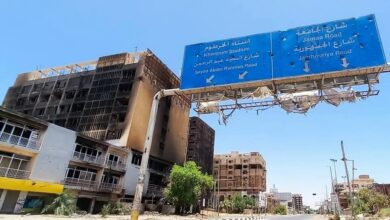
The scars of war remain visible across Khartoum. Part of the Shambat Bridge, once a vital link between the two sides of the city, is still missing after it was hit in an airstrike. In the city centre, abandoned vehicles are scattered around, their tyres stolen and their bodies riddled with bullet holes.
While Sudanese army commander Abdel Fattah al-Burhan sought to portray his return to Khartoum as a major turning point, the backdrop of the images released by the army reveals the extent of the destruction. The Republican Palace is little more than a shell of what it once was, with most of its interior empty after being looted and vandalised by the RSF.
“A Lump in Our Throats”
Despite this, the army is encouraging residents to return. It has rebuilt the airport and reopened it for domestic flights, while beginning to rehabilitate some infrastructure. But this has not been enough to restore basic services. Electricity and water supplies are still cut off for consecutive days, while many people struggle to purchase basic goods as prices remain extremely high and continue to rise daily.
Suad Mohamed Idris, 49, says she returned to her home in Khartoum Bahri only to find that her furniture had been stolen. Unable to afford a new refrigerator, she is now forced to buy food on a daily basis.
The widow and mother of six says, “I have to buy vegetables and meat every day, and prices are high and increasing every day… Yes, we came back longing for our country, but the high cost of living is crushing.”
The return has been concentrated mainly in poorer neighbourhoods, while affluent areas are still waiting for their residents to come back. In Khartoum 2, for example, broken glass is scattered along tree-lined streets, among large houses, some of them destroyed, in a silence broken only by the sound of birds.
A New Displacement
Three months after returning, Thuraya Babiker, 86, is packing her bags once again.
“My husband, my youngest daughter and I will leave… Of course, we did not want to leave, but our health conditions and the difficulty of obtaining medical treatment have left us with no choice,” she says.
The condition of the health sector, which suffered extensive damage during the war, is a priority for many residents. Although charities rehabilitated some hospitals as residents began returning in 2025, many medical supplies remain unavailable.
“We try as much as possible to ensure that patients and their families do not have to undergo tests or X-rays outside the hospital,” says Dr Hafa Omar. “But some medicines are unavailable… We ask patients to buy them from outside the hospital, and we have a lump in our throats because we know the circumstances people are living in.”
Even outside hospitals, medicines are not easy to find, according to Imam Bakr Abbas, who returned to southern Khartoum with his wife, two children and parents after spending three years in Cairo.
Healthcare Crisis
Standing outside a pharmacy, the 34-year-old says, “My father has high blood pressure, and to find his medication, I have to visit 10 pharmacies. Its price changes every day.”
Abbas also struggles to keep insulin refrigerated for his mother, who has diabetes. He explains that he bought a refrigerator, “but the electricity goes out for 12 hours a day, so the insulin spoils.”
Things Are Not Going Well
Khartoum has now become a shadow of what it once was: a major African capital with a population of more than 8 million people. A UN official in Khartoum says the scale of destruction exceeds that seen in all the conflicts the official has witnessed, including Ukraine.
Although the RSF continues to launch sporadic drone attacks on Khartoum, the authorities remain committed to restoring normal life.
In July, they ended the remote-learning system at universities, making it mandatory for students to return. The decision prompted medical professors at the University of Khartoum to threaten mass resignations.
One master’s student says, “The university refused to allow my master’s thesis defence to be conducted online,” even though her supervisor “is in another country.”
Another student, who was supposed to begin her final year of a bachelor’s degree in business administration, is now racing to secure a scholarship in Egypt to resume her studies after missing her in-person examinations this summer.
“They did not listen to us. All they cared about was for people to return,” she says bitterly.
The young woman, who requested anonymity, concludes: “It is political. They want people to return so they can show that everything is fine, but… it is not fine at all.”