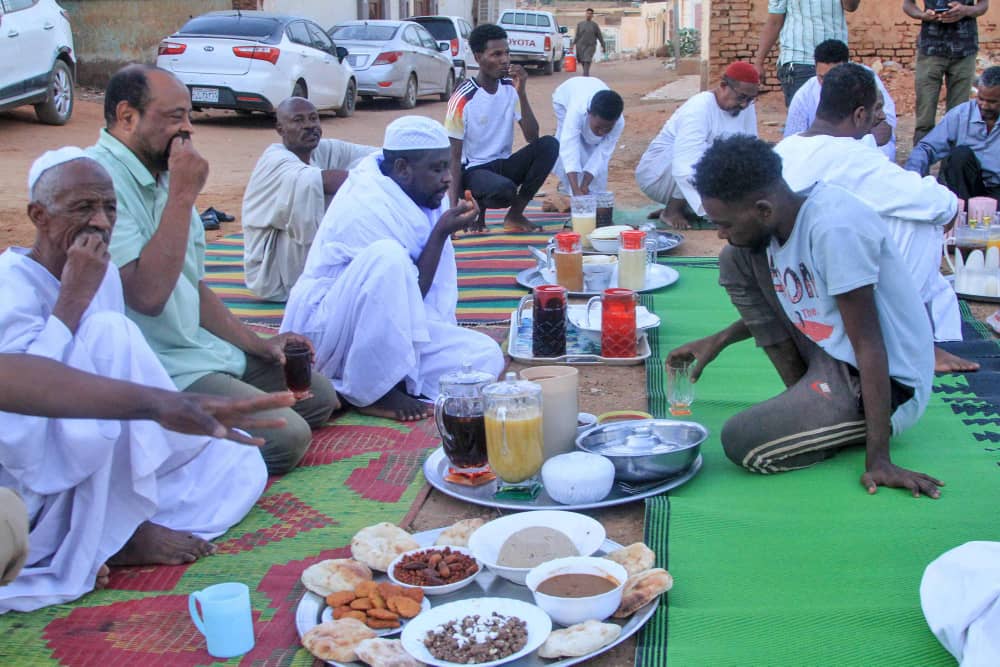
In the Al-Hatana neighborhood of Omdurman, on the bank of the Nile opposite Khartoum, Hassan Bashir and his neighbors spread out a mat and laid out dishes of food at sunset. They were sharing the first communal Iftar of the holy month of Ramadan since the war began nearly three years ago.
Bashir, 53, returned to Sudan a few months ago after being displaced by the conflict. He expressed his joy at restoring a tradition that had been halted by the ongoing war between the army and the Rapid Support Forces (RSF).
Bashir told Agence France-Presse (AFP): “I wasn’t here last Ramadan, but I was present during the Ramadan before that when the war was raging.” He added, “Today I went to the Omdurman market to buy supplies… After what I witnessed during the war, I didn’t expect things to return to normal like this.”
On the first day of the holy month of fasting, Bashir shares his Iftar with men from more than 10 families wearing traditional colored Sudanese “jalabiyas.” Pitchers of traditional drinks like “Hillo-mur”—a drink Sudanese people make during Ramadan from corn flour, are distributed among them.
The battles between the army and the RSF have torn Sudan apart since April 2023, resulting in tens of thousands of deaths, the displacement of millions, the spread of famine in some areas, and the destruction of cities and infrastructure.
Khartoum, which includes the areas of Omdurman and Bahri, was the center of the war for two years. Calm has returned since the army took control in March, opening the door for a slow return to life amidst demolished buildings and the ruins of war.
Abdel Qader Omar, who used to work in trade, said he returned to his home in Omdurman after being displaced three times to the states of Sennar, White Nile, and Al-Jazirah, losing his business in the Omdurman market.
He added: “There were no more than two families here last Ramadan. Today, we are 13 families eating Iftar together, and this is just on one street in the neighborhood.”
Going out into the street for communal Iftar in front of homes is a widespread practice across Sudan; each family brings their food, and neighbors sit together on a shared mat, sharing both food and drink.
However, Omar notes that “while goods are available, the prices compared to income make the situation difficult.” Bashir also confirmed the rise in prices but noted that “Sudanese people help one another through takaya, community kitchens and other means.”
The war led to a deterioration of an already fragile economic situation, with inflation rates exceeding 100 percent. The local currency has suffered a sharp collapse; its value dropped from 570 Sudanese pounds to the US dollar before the war to 3,500 pounds per dollar in 2026, according to black market rates.
The Situation Has Changed
In Khartoum’s central market, vendors display vegetables and fruits in small bags because families cannot afford large quantities.
Mohamed, a vendor at the Khartoum central market, told AFP: “People complain about the prices and say they are exorbitant. You can find everything, but costs are constantly rising—supplies, labor, and transportation.”
Despite this, Omar does not hide his happiness at returning home after “abandoning it for a long time. But when we returned, we found the place safe and people had returned to their houses.”
Osman Al-Jundi, a journalist who never left Omdurman throughout the war, told AFP that “the situation is completely different compared to Ramadan 2025.” He added, “This street of ours had only two families; now there are 16.”
Numairy Al-Sheikh Taha recalls that in previous years in Omdurman, “we used to sit in fear; a stray bullet might hit us or a shell might land even inside the houses. Artillery hit our neighbor’s house.”
About 400 kilometers southwest of Khartoum, the cities of Kordofan are still witnessing bloody battles. Drone strikes have intensified, some killing dozens in a single attack. Even so, Sudanese people spread mats in front of their homes to eat Iftar together.
Ahmed Bella, a resident of the Al-Bitrol neighborhood in El-Obeid, the capital of North Kordofan, told AFP by phone: “We are 17 families who are used to eating Iftar together during Ramadan. Today, not one of us was absent despite the security situation and drone attacks from time to time.”
The RSF has been trying to re-encircle El-Obeid since the army broke a long siege on it in February 2025. The two sides are engaged in fierce battles in North Kordofan for control of a major hub for vital supply routes between the east and west of the country that passes through El-Obeid.
In South Kordofan, where heavy shelling continues, the Integrated Food Security Phase Classification which includes governments and international agencies, declared a famine in the capital, Kadugli, which was besieged by the RSF until the beginning of this month. They warned of similar conditions in Dilling in the same state.
According to the United Nations, more than 21 million people, nearly half of Sudan’s population, face high levels of acute food insecurity.