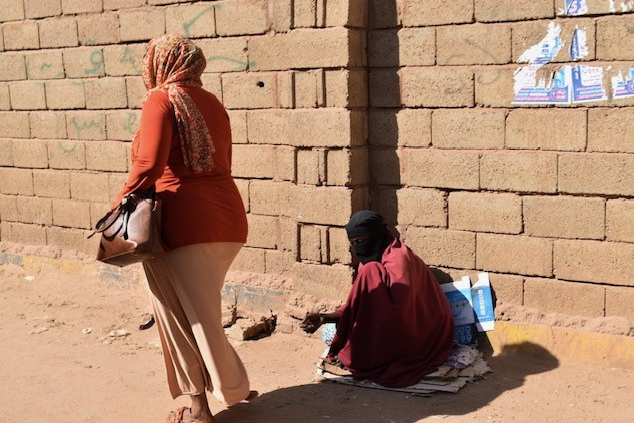
The phenomenon of begging in Sudan has surged noticeably during the war, but it has expanded further in recent times, especially in Khartoum State. What was once a limited social behavior has transformed into a worrying security concern, becoming both a security and social issue in the capital. This shift comes with the emergence of new groups and unfamiliar faces, including street children, female beggars, and elderly individuals without care, prompting authorities to declare a direct campaign against homelessness and begging, which have spread alarmingly across the streets of Khartoum.
Widespread Campaigns
Last March witnessed extensive and intensive security campaigns conducted morning and evening by authorities in Khartoum State to combat begging and homelessness. These campaigns targeted gathering hotspots in streets and markets across localities such as Karari and Bahri.
On the third day of these operations, authorities announced the arrest of more than 800 beggars. Foreign nationals among them were transferred to designated areas (such as Al-Jarif West) to complete procedures for departure from the country.
A joint force comprising various security agencies continues to carry out large-scale raids to apprehend those involved in begging, aiming to restore public order and protect the city’s appearance.
Screening and Verification
Official sources revealed that all detainees were immediately transferred to Al-Jarif West, in direct coordination with the Foreigners Monitoring Branch of the General Directorate of Passports and Immigration. They are currently undergoing legal screening, identity verification, and classification procedures in preparation for administrative and legal decisions.
The Ministry of Social Development has instructed the preparation of an accurate census of homeless individuals, their classification, and the updating of their data. It has also formed specialized technical committees to develop a comprehensive strategy to address the phenomenon of begging and to document the homeless population.
A Security File
The ministry announced the start of a comprehensive review of laws aimed at curbing negative phenomena and protecting public security, alongside taking firm legal and administrative measures against beggars and the homeless to ensure stability and order. Social researchers have also participated in the campaigns to study cases and provide appropriate care rather than relying solely on punitive measures.
The Acting Minister of Social Development in Khartoum, Sadiq Farini, emphasized the launch of major campaigns to combat the phenomenon, describing it as “no longer just a social challenge, but a security issue threatening the safety of citizens in the state, requiring firm action.”
War and Expansion
Sociologist Ibrahim Mohamed Saeed explained that begging in Sudan has expanded significantly during the war due to multiple overlapping factors that have disrupted entire productive sectors—commercial, service, and agricultural—across the country. As a result, begging has become a means of survival for many families rather than a marginal choice.
He noted that this is the most dangerous and fastest-growing type, evolving from spontaneous acts into organized begging, making it a real concern that compels authorities to act urgently.
Integrated Measures
Saeed stressed that addressing the phenomenon cannot rely solely on security measures but requires a comprehensive approach involving integrated social policies to address the deep impacts of war on Sudanese society. This should be part of a long-term process of social and humanitarian recovery and reconstruction.
He added:
“The sharp economic collapse, the depreciation of the national currency, the unprecedented surge in prices, along with internal displacement and the loss of jobs, income, and homes by millions, have all pushed thousands toward begging.”
He pointed out that the problem is worsening due to the absence of social protection networks and insufficient support in shelters for displaced people who moved to overcrowded cities without job opportunities. Many who were once productive in their villages or towns have become beggars in their new environments.
Exploitation Networks
Saeed did not rule out the existence of networks exploiting women and children, targeting newcomers and undermining family and social structures. This reveals the organized dimension of the phenomenon, with possible links to human trafficking or overlaps with other informal activities.
Organized urban begging is considered the most dangerous from a security perspective, as it can evolve into human trafficking or even intelligence recruitment for armed groups or drug gangs. It can also create a lasting criminal infrastructure even after the war ends. Such networks may become profitable economic activities, encouraging expansion under humanitarian cover.
The emergence of new categories, such as street children and female beggars, signals a threat to the future and a long-term crisis affecting generations to come.
“Trojan Horse” Warning
Writer and academic Musab Bareer warned that what he described as a “Trojan horse” of unfamiliar beggars could once again undermine the security of the Sudanese capital.
He noted that Khartoum is returning to a troubling scene familiar before the outbreak of the war, with a noticeable increase in foreign beggars, many of whom do not speak Arabic or speak it poorly, moving in groups of men, women, and children.
While the scene in the streets of Omdurman, Khartoum, and Bahri may appear humanitarian on the surface, it raises deeper concerns beyond mere poverty.
Organized Waves
According to the academic, what is striking is that these beggars did not appear individually as usual but arrived in organised waves. Some reports suggest they were transported by buses and trucks to Khartoum State, as if a coordinated entity was responsible for relocating and distributing them strategically within the Capital.
He added:
“In several neighborhoods, some have begun living in abandoned houses or working as guards or domestic workers, which raises concerns among residents who remember how certain networks infiltrated cities before the war under similar social covers.”
The experience of war has taught Sudanese people that cities are not always penetrated first by weapons. “Sometimes the story begins with what appears to be a normal presence—foreign workers, beggars, or unfamiliar individuals—then later evolves into information networks or footholds used by hostile actors when needed.”
Therefore, he stressed the importance of addressing unusual phenomena seriously from the outset, as major crises often begin with seemingly ordinary details.
Suspicious Activities
Bareer called for official campaigns to document beggars and verify their identities, monitor transportation means bringing them into the capital through coordination between police, specialized agencies, and neighborhood committees, and establish hotlines to report suspicious cases.
He also emphasized the role of the community in acting responsibly by reporting unusual phenomena, knowing who occupies abandoned houses or works within neighborhoods. These are simple but important preventive measures.
Ultimately, security is not solely the responsibility of the state, but a system in which citizens also play a crucial role.
Khartoum, he concluded, has paid a heavy price in the past for underestimating early warning signs.